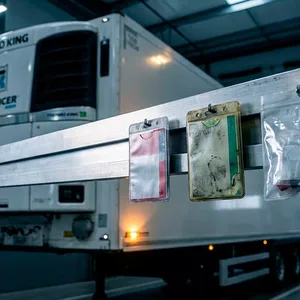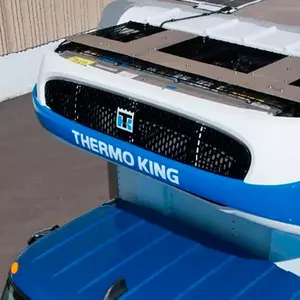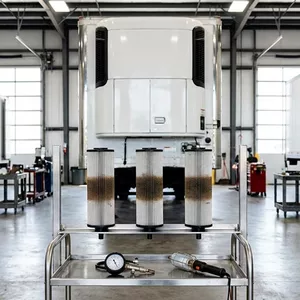


Winter does not usually take a Thermo King unit down in one clean moment. The trailer still leaves the yard. The load holds. What changes first is the pattern. The morning start drags longer than it did last week. A restart after dock dwell comes back slower. A fuel complaint appears after an overnight park, fades in the afternoon, then returns with the next temperature drop. In fleet work, that pattern matters before a full no-start ever shows up.
Chicago-area operation exposes weak winter units quickly. Overnight exposure, pre-dawn departures, dock time, short interruptions, suburban stop density, and repeated restarts leave very little room for a reefer to recover between events. A unit that felt acceptable in mild weather can become expensive over a single cold stretch.
The first real question is not about a part
The first call usually sounds like a dispatch question: can this unit go back out tomorrow?
That question leads to two very different service paths. Some trailers still belong in seasonal maintenance, where planned winter attention keeps a stable asset reliable. Others have already crossed into repair routing, where sending the unit back out means accepting a risk that is likely to land harder later. Getting that call right is the center of winter Thermo King service.
Fuel-side instability and alternator-side weakness belong in the same conversation because restart reliability depends on both. A unit can crank hard because charging recovery is slow. It can restart inconsistently because fuel delivery becomes less stable in lower temperatures. It can show both patterns in the same week. Fleets lose time when those complaints are treated as unrelated small events.
Documented cold-weather logic explains why one restart is not enough
On documented Thermo King Precedent and SR-4 operating logic, cold-weather restart behavior runs on defined thresholds. In Cycle-Sentry diesel mode, restart occurs when battery voltage drops to 12.2 V. Cold-weather auto-start logic is triggered when engine block temperature falls below 30 °F (-1 °C). After a cold start, charging continues until current falls below 5 A. The engine continues running until block temperature exceeds 90 °F (32 °C).
Those figures matter because winter service should be judged by recovery behavior, not by one successful start. A unit that restarts after a cold soak may still be recovering too slowly for normal fleet duty. A unit that keeps needing long recovery time between stops is already showing weak operating margin, even if it has not produced a terminal no-start event yet.
| Documented operating threshold | Service meaning in winter |
|---|---|
| 12.2 V restart threshold in Cycle-Sentry diesel mode | Charging weakness affects whether the unit can rebuild enough margin between cold starts. |
| 30 °F auto-start trigger from low block temperature | Ambient cold is part of the complaint itself, not just the backdrop around it. |
| Charging continues until current falls below 5 A | Slow post-start recovery is an early reliability signal. |
| Cold-start run continues until block temperature exceeds 90 °F | Morning readiness depends on full recovery, not only on whether the engine fired once. |
Why alternator complaints get worse in winter
Cold weather cuts available battery output at the same time it raises the energy needed for cranking. In winter guidance used in Thermo King service context, available battery output can drop by as much as 50 percent while the engine needs more current to start against thickened oil. Less stored energy and higher starting demand are exactly the conditions that expose a marginal charging system.
The failure paths are familiar in reefer service. Brush wear that was tolerable in warm weather becomes visible under cold-load recovery. Diode bridge corrosion reduces effective output. Ground-path degradation lowers charging performance when the unit needs the strongest recovery cycle of the day. Road salt makes all of that harder on the electrical side.
Most alternator complaints do not begin with one dramatic dead-charge event. They show up first as weak recovery between starts, longer-than-normal charging behavior after a cold start, and a trailer that seems usable on a long run but becomes unreliable after short stops. Dispatch sees the effect before the shop names the mechanism.
Why winter fuel complaints look inconsistent before they look serious
Standard diesel begins thickening in the 10 °F to 20 °F range. As paraffin crystals form, filter resistance becomes less predictable and fuel delivery loses stability. A trailer may restart after one stop and hesitate after the next. It may hold temperature and still show a fuel pattern that no dispatcher can plan around with confidence.
That inconsistency is what matters here. The full no-start often comes later. Once a Thermo King unit starts showing behavior that shifts with overnight exposure, changes with temperature, and refuses to repeat cleanly from one restart to the next, the fuel-side issue belongs in a service decision, not in a wait-and-see conversation.
Alarm status changes the routing decision
Thermo King alarm logic helps separate a softer winter complaint from a more serious repair path. Code 17, Engine Failed to Crank, is treated as a yellow-status event unless the unit is shut down. Code 44, Check Fuel System, is a red-status signal. That difference matters because not every winter complaint deserves the same timing, and not every non-terminal event is harmless.
A unit that logs Code 17 repeatedly while continuing to operate is losing electrical margin on a schedule, not at random. A red fuel-system event compresses the routing timeline further. Using that distinction correctly helps fleets avoid two common mistakes: overreacting to every isolated complaint and underreacting to recurring winter patterns that are already moving toward a bigger failure.
| Winter complaint pattern | Operational meaning | Best service path |
|---|---|---|
| Hard first start after overnight parking | Cold-start margin is already getting thin | Winter reliability evaluation before the next early departure |
| Weak restart after dock dwell or short stop | Charging recovery is too slow for repeated winter use | Repair routing, not routine PM |
| Fuel hesitation appears only in colder windows | Fuel delivery stability is affecting restart consistency | Corrective service before route assignment |
| Code 17 repeats without full shutdown | Non-terminal starting problems are eroding reliability | Do not dismiss the pattern because the trailer finished the day |
| Code 44 appears | Fuel-system complaints have moved into serious service territory | Escalate before the next dispatch cycle |
Service Watch turns a description into a pattern
A driver report is a starting point. Service Watch gives technicians something firmer to work with. Roughly 90 days of operating history can show extended charge cycles, repeated restart attempts, alarm clustering around overnight parks or short-stop sequences, and recovery times that have been trending longer across weeks.
The most expensive winter complaints are often the least dramatic ones. They build quietly while the unit keeps finishing shifts. Better history produces better routing and gives the shop a better chance to fix the real complaint before it becomes a terminal failure in the middle of a load schedule.
Pre-trip results are a routing decision, not a formality
A passed pre-trip is not a winter guarantee. A failed pre-trip is a hard signal that the complaint has already moved beyond casual observation. Automated pre-trip diagnostics run for approximately 15 minutes and test core operating functions under controlled conditions.
When a unit is already showing hard cold starts, slow charging recovery, fuel hesitation, or recurring alarm activity, a failed pre-trip should close the routing question. Sending the trailer out in hope of a cleaner run is not a winter strategy. It is a postponed repair.
What winter service should cover
Winter reefer service has to do more than identify one weak component. It has to read the complaint correctly, weigh the operating history, and decide whether the trailer belongs in seasonal reliability work or corrective repair before the next dispatch window tightens the risk.
- Evaluation of Thermo King winter complaints on trailer refrigeration units
- Cold-weather restart and hard-start assessment
- Alternator and charging-system reliability diagnosis under winter load conditions
- Fuel-side winter complaint interpretation and repair routing
- Alarm-aware complaint review, including Code 17 and Code 44 significance
- Service Watch pattern review when operating history changes the diagnostic picture
- Readiness decisions for units that still run but no longer hold dispatch confidence
Where charging-side complaints point toward component replacement, the quality of the fix matters in a road-salt environment. Genuine Thermo King Extended Life alternators carry epoxy powder-coat corrosion protection and a 24-month parts warranty. Those details affect service life after the repair, not just the repair itself.
What dispatch should send in before the unit arrives
Winter intake works better when dispatch sends the pattern, not a guessed component.
- Did the problem happen on the first start, after overnight parking, or after a short stop?
- What was the ambient temperature when the complaint appeared?
- Did the unit hold temperature while restart confidence dropped?
- Did the pattern look like weak charging recovery, fuel hesitation, or a mix of both?
- Has the unit logged Code 17, Code 44, or other winter alarm activity recently?
- Did the last pre-trip pass cleanly?
- Has the same complaint repeated across several cold mornings?
- Is there Service Watch history showing extended charge cycles or repeated restart attempts?
That intake sharpens the service path before the unit arrives and helps prevent the most expensive winter mistake in reefer work: treating a recurring pattern like a series of unrelated small events.
What a strong winter result looks like
A strong winter result means the complaint is classified correctly and the repair matches the real risk. The unit goes back out. The next cold stretch is not a gamble.
If your fleet is dealing with Thermo King hard starting in cold weather, weak charging recovery, Code 17 or Code 44 activity, or fuel-side complaints that shift with temperature, bring the pattern in before the next cold dispatch window. Our team reviews the operating history, separates seasonal attention from real repair exposure, and returns the unit to service on a decision you can rely on.
Illinois Service Area
Primary service coverage extends across Illinois, including Chicago-area freight facilities, fleet yards, docks, and major interstate routes. Fleet work in Indiana or another state may be arranged when travel, access, schedule, and scope are confirmed in advance; it is not represented as blanket local coverage.