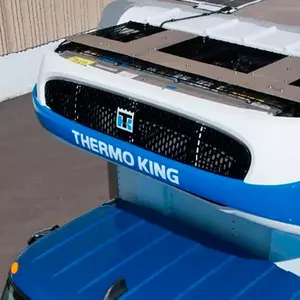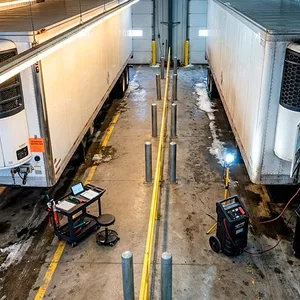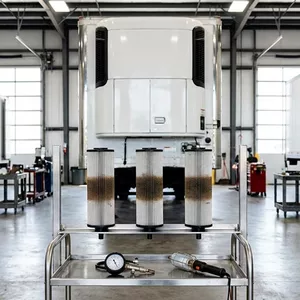


If a Thermo King Advancer unit is stable and simply overdue for interval work, schedule preventive maintenance. If it still cools but starts drifting after dock turns, slows its pull-down, or comes back with the same complaint after recent service, it belongs in a different lane. That is where fleets lose time: the trailer is still moving, so the problem gets treated like routine PM when it has already turned into a performance or diagnostics issue.
Advancer A 360, A 400, and A 500 units do not have to fail hard before they start costing money. In Chicago distribution work, a reefer can look acceptable at pre-dispatch and then lose control later in the shift. On longer Illinois mileage, the same weakness may stay hidden until steady runtime eats up the unit’s margin. Our reefer team treats those as different service calls, not as one generic “reefer not cooling right” complaint.
What usually brings an Advancer unit into service
Most Advancer calls start with one of four complaint patterns.
- Setpoint drift later in the route. The trailer settles, runs, then starts losing discipline after recovery events that used to feel normal.
- Weak pull-down. The unit still reaches temperature, just slower, with less margin, and with more schedule pressure attached to the same load.
- Uneven runtime or unstable cycling. Not a clean breakdown. A trailer that keeps correcting, keeps working, and keeps coming back.
- Soft recovery after door openings. In Chicagoland stop-and-go work, a trailer has to settle repeatedly through the day, not once.
Those patterns should not be grouped together. A unit that loses setpoint after the second stop is a different job from a unit that cannot pull down at all. A trailer that is stable but overdue for interval service is a different job from one that already needs controlled diagnostics.
Advancer A 360, A 400, and A 500 service context
| Model family | Typical operating context | What changes the service read |
|---|---|---|
| A 360 | Steady refrigerated trailer work with heavier emphasis on consistent pull-down and temperature holding | The key question is whether the unit still matches its normal baseline under load |
| A 400 | Mixed-duty fleet use with wider route variation and more stop-and-go exposure | Complaint timing matters because interval condition and performance loss can look similar at intake |
| A 500 | Higher-demand operation where airflow, recovery, and runtime behavior stay under pressure longer | A short yard pass can miss the same weakness that appears later in the shift |
Exact model capture belongs at the front of the booking, not halfway through the visit. On Advancer work, the unit family, target temperature, route pattern, recent service history, and the point in the day when the complaint first appears will usually narrow the lane faster than a long list of guessed parts.
Scope boundaries
- Trailer TRU service focused on Thermo King Advancer family equipment
- No trailer body, insulation, door, or structural trailer repair in this service lane
- No fault-code encyclopedia and no reset-style troubleshooting content here
- No small van or last-mile refrigeration scope in this track
Where routine preventive maintenance ends and controlled diagnostics begin
Advancer preventive maintenance still matters. Stable units need real interval work, and skipping it creates its own cost. The problem starts when every complaint gets pushed into PM even after the trailer has already begun slipping under route conditions.
| Observed pattern | What it means for operations | Best service lane |
|---|---|---|
| Stable unit, overdue for interval work, no strong runtime complaint | Maintenance condition is the main exposure | Scheduled preventive maintenance |
| Pull-down or recovery is getting softer, but the complaint is still early and controlled | The trailer is losing operating margin before becoming downtime | Performance-focused maintenance service |
| Setpoint drift, unstable cycling, repeat complaints, or the same symptom after recent work | The issue has moved beyond interval-only service | Controlled diagnostics and repair scoping |
| Active load risk, in-transit interruption, or urgent loss of cooling discipline | Stabilization becomes the first business priority | Mobile stabilization followed by planned follow-up service |
If the trailer fits the third or fourth row, book it that way. Sending the model, route, and symptom timing with the request usually removes one unnecessary bay visit before the real work even starts.
Mis-scoping patterns that cost fleets the most on Advancer units
The expensive mistake on Advancer calls is often made at intake. A trailer gets described as “not cooling right,” the complaint sounds survivable, and the unit gets routed into the wrong lane because it still looks calm during a short first check.
A possible operating complaint during repeated dock work is: the trailer clears pre-dispatch, handles the first load, and then falls behind on the second loading cycle. Another shows up later and farther out. The same weakness on a longer Illinois run may stay hidden until steady runtime has already used up whatever margin was left.
A 400 and A 500 complaints also get mislabeled as simple airflow problems more often than they should. On Advancer equipment, the first diagnostic split is different. The 48V mild-hybrid architecture changes how airflow behavior gets read against engine speed, and treating it like an older trailer TRU is where intake gets expensive.
That is why a short yard pass is not always a real pass. If the complaint only appears after repeated door openings, later in the route, or after the second stop, the service read has to be built around the live operating pattern that triggers it.
Common Thermo King Advancer complaint patterns
Advancer not holding setpoint after a normal recovery window
A trailer loads on time, leaves the yard, then starts drifting after what should have been an ordinary recovery event. No hard shutdown. No dramatic alarm story. What changed is the amount of control the unit still has in reserve.
In Chicago-area distribution work, this often shows up after repeated dock turns instead of at the first stop. A trailer can look acceptable at pre-dispatch and still be a bad release later that day.
Weak pull-down under real commercial load
Weak pull-down is easy to underestimate because the trailer still reaches temperature eventually. The cost lands in delay, extra runtime, and a tighter dispatch window on the next leg.
A trailer can appear normal before departure and still fall behind on the second load. On a longer Illinois route, the same problem may surface later, after sustained runtime has already eaten into the unit’s margin. Either way, the fleet is paying for a trailer that no longer behaves like it used to.
Unstable cycling or runtime drift that keeps returning
Some Advancer units never give operations a clean reason to stop the trailer. The complaint stays soft, the unit stays dispatchable, and the same trailer keeps finding its way back into the bay. That is usually the point where routine maintenance has already stopped being the right answer.
When the same runtime complaint survives recent work, the next call should be treated as a diagnostics and repair-scoping problem. Fleets do not lose money because the symptom sounds dramatic. They lose money because it keeps surviving quiet service visits.
Recovery loss after repeated door openings
Door activity is normal fleet work. Recovery should still look controlled. When the trailer takes longer to settle after ordinary loading events, especially in Chicagoland stop-and-go work, the complaint belongs in the operating context where it appears. Pull it out of that context and the unit gets under-scoped.
Release criteria that matter on an Advancer unit
A vague maintenance-complete note does not help operations if the original complaint was slower pull-down on the second load or setpoint drift later in the shift.
- Pull-down complaints should be closed against pull-down performance, not against the fact that the trailer cooled eventually.
- Recovery complaints should be judged by how the unit settles after normal operating events, not only by a calm first-start impression.
- Repeat complaints should leave the bay with a narrower explanation than the one that brought the trailer in.
- Controller-sensitive or configuration-sensitive work should return the unit with continuity in operating behavior, not just with a part changed.
Advancer units can keep moving freight while performance is already slipping. A trailer that survives dispatch is not automatically a trailer that should have been released.
Repair or maintenance, and when waiting gets more expensive
If the unit is stable and the main exposure is interval condition, maintenance is still the correct lane. If the complaint has already returned after recent work, if pull-down now costs the trailer extra time on the same route, or if the problem only appears under live duty, the visit has already moved toward repair-oriented service.
A PM stop that puts a drifting A 400 back on the road usually costs the fleet another visit, another dispatch slot, and another round of uncertainty about whether the trailer is actually ready. The wrong lane is often more expensive than the first repair decision.
What to have ready when booking Thermo King Advancer service
- The exact unit family, especially whether the trailer is running an A 360, A 400, or A 500
- The target temperature and the route or load where the complaint becomes visible
- Whether the issue is setpoint drift, weak pull-down, unstable cycling, slow recovery, or a broader runtime change
- Recent service or repair history on the same trailer
- Any controller note or alarm reference, without reducing the whole complaint to a code search
- A real field example helps: “stable in the yard, weak after the second stop” is better intake than “reefer acting up”
Thermo King Advancer repair and maintenance for Chicago, suburbs, and Chicagoland fleet operations
Our reefer team handles Advancer calls as transport refrigeration service, not as a generic refrigeration add-on. That changes the intake, the lane choice, and the release standard. Model family matters. Route pattern matters. So does the moment the complaint first shows up.
If your Advancer trailer is losing setpoint after recovery events, slowing its pull-down, cycling unevenly, or coming back with the same complaint after recent service, request the job with the model, target temperature, route pattern, and symptom timing included from the start. That gives our team enough to route the trailer into preventive maintenance, controlled diagnostics, repair scoping, or mobile stabilization before the next dispatch turns a soft complaint into a harder failure.