

Summer reefer complaints in Chicago usually start with moisture, not with a dramatic loss of cooling. Warm humid air enters the box at docks, during repeated door openings, and across stop-start delivery routes. Once that moisture begins loading the evaporator, a Thermo King trailer can lose airflow, clean pull-down, and cargo stability even while the setpoint still looks close enough to avoid an immediate shutdown.
A trailer burning runtime without restoring coil performance is already a service case — and a temperature check alone will not find it. Fleets need to know whether defrost logic is clearing the coil effectively, whether humidity control is protecting the load instead of drying or wetting it, and whether the trailer still belongs in a tuning path instead of a wider repair decision.
Hot gas defrost controls summer coil performance before the load feels the problem
On Thermo King trailer units, hot gas defrost uses high-pressure refrigerant vapor leaving the compressor and routes it to the evaporator to melt frost from the coil. That matters because summer efficiency depends on coil condition. Once frost starts building across the evaporator, the unit loses heat-transfer surface and airflow at the same time. The trailer may still run hard while delivering weaker recovery after openings and less stable cargo conditions on humid routes.
The real defrost question is whether the cycle is restoring effective coil operation — not just whether it is starting on schedule. If the trailer returns to service with the same frost-loaded behavior after a few humid stops, the cycle has consumed runtime without solving the underlying summer problem.
SR-4 Demand Defrost is supposed to react to ice loading, not just to the clock
SR-4-era Demand Defrost logic is one of the clearest technical markers that separates a modern Thermo King summer-performance complaint from a generic reefer complaint. The controller can initiate defrost when the temperature difference around the coil and air stream becomes excessive, which means it is reacting to actual evaporator loading rather than relying only on a fixed timer.
That matters on Chicago and Chicagoland routes where the trailer does not stay in one steady-state condition for long. Door openings, dock pauses, and humid urban delivery work can change the evaporator load faster than a simple timed strategy can account for. When the unit keeps terminating defrost by time instead of by restored coil condition, the controller history is already pointing at a real performance problem.
Code 14 is the strongest example. Defrost Terminated by Time is not just a memory entry. It shows that the evaporator may not be clearing frost efficiently enough for the route, the humidity load, or the box condition the fleet is actually running.
ETV control and Thermo King humidity management protect cargo quality, not only temperature
Humidity control matters because cargo can be damaged before the fleet sees an obvious warm-load event. Wet packaging, product shrink, surface moisture, and top-freeze can all start while the trailer still appears to be holding temperature reasonably well. That is why humidity control needs to be treated as a summer performance service issue, not folded into generic reefer wording.
The electronic expansion valve, or ETV, is central to that control layer. ETV logic supports tighter refrigerant-flow control around evaporator conditions, which helps stabilize load treatment near setpoint and under hard summer load. In practical fleet terms, that control precision smooths pull-down behavior, reduces the hard-running coil pattern that drives dehydration on sensitive freight, and limits the pressure spikes that appear when the unit is working against peak humidity. A unit whose ETV is hunting or poorly calibrated may still cool, but it will handle the load unevenly in ways that do not always register as a clean temperature miss.
Humidity control also depends on usable sensor input. On AHC-equipped setups, the humidity sensor is part of the control picture, not a decorative add-on. If the trailer is reading box moisture poorly, the unit keeps reacting to the wrong conditions, and the fleet keeps seeing complaints that sound different each week but trace back to the same unresolved control problem.
Chicago summer routes stress the box differently than quiet highway lanes
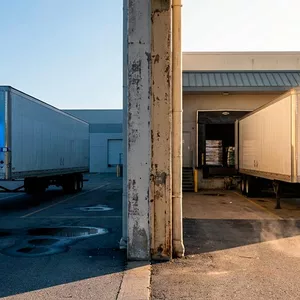
A trailer on a long steady run gets time to recover. A trailer running humid city docks, short suburban drops, and repeated stop-start delivery patterns across Chicagoland often does not. The box keeps taking in warm moist air before the evaporator has fully cleared the last load of it. Lake-driven humidity makes that worse in the Chicago market, especially when the trailer spends part of the day on hot pavement and part of it waiting at open docks.
A unit that seems acceptable on a calm lane can become the same unit that starts producing wet cargo, weak pull-down, or repeat defrost problems once it moves into heavier dock dwell and more frequent openings. Summer performance service has to be built around that operating pattern, not around a generic assumption that every reefer is being tested the same way.
Which Thermo King trailers most often surface this kind of complaint
Most of this work shows up on Thermo King trailer fleets where summer performance depends on stable control behavior rather than on brute cooling alone. Precedent-family equipment such as S-600 and S-700 units running SR-4 logic tends to surface these issues clearly because Demand Defrost behavior, ETV modulation, and route sensitivity all become visible once humidity starts loading the evaporator repeatedly.
The first decision is whether the trailer still fits a tuning path, whether the problem has already widened into repair scope, or whether the complaint is being amplified by loading practice, box leakage, or operational habits that keep rebuilding moisture faster than the unit can clear it.
Complaint patterns that usually point to hot gas defrost and humidity-control service
Wet cargo or damp packaging on loads that do not look obviously warm
When cartons are wet, surfaces are damp, or product condition is drifting even though the box is not showing a dramatic temperature miss, the problem usually sits in the relationship between humidity, evaporator condition, and airflow. That is not a cosmetic issue. It is often the earliest visible sign that the trailer is losing control of moisture before it loses obvious cooling capacity.
Pull-down that fades after several openings
A trailer that starts the route well and then loses sharpness after repeated stops is usually carrying a moisture-load problem through the day. Each opening adds humid air. Each dock pause gives that moisture more time to settle into the box. Once frost begins loading the evaporator, practical recovery falls off faster than the fleet expects.
Top-freeze or product shrink on moisture-sensitive freight
Some summer complaints come from the wrong kind of cooling rather than from too little cooling. Product can be damaged when the trailer handles moisture poorly near setpoint, drives the air too hard across sensitive surfaces, or loses stable ETV modulation under a changing route load. When freight arrives cold but wrong — shrunken, surface-frozen, or unevenly conditioned — the control side of the complaint deserves the first look, not just the temperature log.
Defrost activity that keeps consuming runtime without cleaning up performance
Repeated timer-terminated defrost history, weak post-defrost recovery, or a trailer that quickly returns to frost-loaded behavior after a few humid stops all point toward a service decision. The complaint is no longer "it ices a little." The complaint is that summer runtime is being spent without restoring the evaporator to the condition the route requires.
When the complaint belongs in service work, not in PM language
Preventive maintenance has its own owner role. This topic is narrower. Hot gas defrost tuning and humidity control service belong here when the trailer is still operating but no longer managing humidity, frost, and airflow cleanly enough for summer duty. Wet cargo complaints, repeated code 14 history, weak recovery after multiple openings, and moisture-sensitive freight problems all fit that pattern.
The service value is in separating three different paths before the fleet approves the wrong work:
| Complaint state | What it usually indicates | Likely service path |
|---|---|---|
| Humidity and defrost behavior are unstable, but the unit is still structurally healthy | Control and operating-pattern problem | Tuning and summer performance review |
| The trailer keeps returning with the same complaint under different names | One unresolved summer logic problem is still active | Deeper repair review or wider scope decision |
| Loading, seals, airflow, or trailer-envelope issues are driving moisture faster than the unit can manage it | Operational and box-condition amplification | Operational correction plus service review |
Loading and box conditions can convert a controllable trailer into a repeat complaint
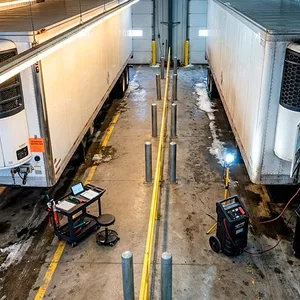
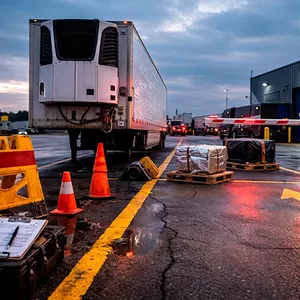
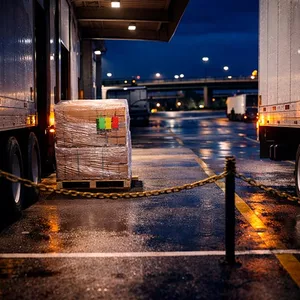
Open-door dwell is one of the fastest ways to overwhelm a summer-loaded evaporator. A trailer waiting at a Chicago dock with the doors open for 20 to 30 minutes can take in enough warm humid air to rebuild the same frost load the last defrost cycle cleared. That is not a refrigeration failure — it is a heat and moisture input the unit was never sized to ignore. Fleets running dense suburban routes with multiple stops per hour see this compound quickly.
Tight ceiling loading, blocked return-air paths, and poor pallet clearance make the problem worse by distorting airflow through the box. A reefer can only manage the air it can move. Once loading practice starts choking return air, the trailer may look underpowered even when the refrigeration circuit is still capable.
Door seals, drainage, and trailer integrity belong in the same review. Worn seals keep feeding moisture into the box between stops. Poor drainage lets water accumulate where it should be leaving the trailer. Neither issue is dramatic, but both can rebuild the same summer complaint after a bay visit that looked successful on a short test run.
What our team reviews before approving a summer tuning path
Our intake on a humidity complaint starts with the route pattern, the freight, and the complaint history. A city route with constant dock exposure should not be judged the same way as a steadier lane with fewer openings. From there, our team reviews whether the unit's behavior matches a tuning case or whether the complaint has already widened beyond that.
- Demand Defrost behavior against the real duty cycle the trailer is running
- Code history, especially repeated time-terminated defrost events
- ETV-related control stability on freight where shrink or top-freeze matter
- Door openings, dock dwell, and stop-start work that keep rebuilding moisture load
- Return-air obstruction, pallet spacing, and loading patterns that distort airflow
- Door seals, drainage, and trailer-envelope leakage that keep feeding humidity into the box
A trailer that improves for one run and then returns to frost-loaded evaporator behavior within the next two dock cycles has a route-sensitive summer problem still operating in the background.
What a clean summer release standard looks like
On SR-4-era equipment, a 15-minute Full PreTrip is a useful screening benchmark, but it is the start of release confidence, not the finish. A trailer is summer-ready when it can recover on humid stop-start routes without rebuilding the same complaint pattern — stable defrost behavior, moisture control that fits the cargo, and airflow that is not being strangled by frost or box conditions. If the unit still returns to wet cargo behavior or code-14-style defrost history after the same route profile, the job is not closed.
Summer efficiency slips one recurring penalty at a time
Fuel burn rises. Runtime stretches. Defrost consumes time without restoring clean coil performance. Humidity keeps re-entering the box before the last load of it has cleared. Airflow settles later, or not at all. ETV has to work harder to protect the same freight under more chaotic conditions. Those penalties do not announce themselves. They accumulate across a fleet in ways that show up first as repeat service visits and cargo complaints, not as a single clean breakdown.
When fleets review defrost history against route pattern and cargo complaints, most of these trailers look less like sudden failures and more like unmanaged summer performance cases. The problem was visible in the code history. It was visible in the route pattern. It only needed someone to read both at the same time.
Put repeat summer complaints into service review before the next heat wave sorts them out
Wet cargo complaints, repeated code 14 history, weak recovery after multiple stops, humidity-driven product issues — any of those patterns means the trailer is already telling you what summer is about to cost. The time to act is before the next hot humid week converts the same complaint into a cargo claim or a roadside call.
Call us with the complaint history, the route pattern, and the freight type. Our team will sort a hot gas defrost and humidity-control tuning case from a wider repair case before the trailer goes back into hard summer duty — not after it comes back with the same problem under a different name.
Illinois Service Area
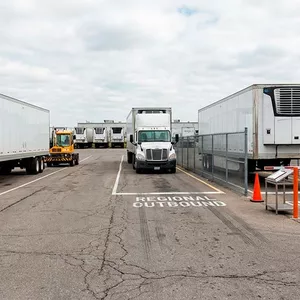
Primary service coverage extends across Illinois, including Chicago-area freight facilities, fleet yards, docks, and major interstate routes. Fleet work in Indiana or another state may be arranged when travel, access, schedule, and scope are confirmed in advance; it is not represented as blanket local coverage.