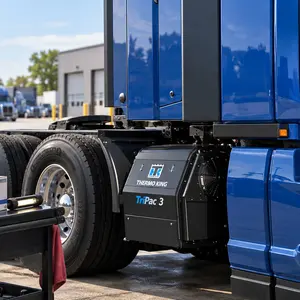


A TriPac alarm is an event to investigate, not a component diagnosis. The display may report a shutdown, a power condition or a system warning, while the cause depends on the APU generation, installed options and what the truck was doing when the event appeared. Clearing a message without preserving that context can remove the best clue available for service.
Thermo King TriPac APU diagnostics should identify the exact tractor-side platform, capture the alarm as displayed and follow the failed operating sequence. Useful service preparation preserves evidence and explains the diagnostic path. It does not function as a fault-code encyclopedia, reset guide or substitute for the operator manual assigned to the unit.
Confirm that the complaint belongs to the tractor APU
TriPac supports sleeper-cab comfort and auxiliary electrical needs. Its external equipment is mounted on the tractor frame rail, while the driver control panel is in the cab and other climate components may be under the bunk. It does not control the refrigerated trailer's cargo box.
If the alarm appears on a controller attached to the front of a refrigerated trailer, record it as a trailer TRU issue. Do not report that message as a TriPac code merely because both products carry Thermo King branding. The equipment location is the first scope check.
Identify the TriPac platform before interpreting the event
Start with the product name, model information and serial number from the installed system. TriPac 3 and TriPac Evolution are diesel APU platforms, but they are different generations. TriPac Envidia is an electric APU architecture. Similar service symptoms do not make their controls, components or diagnostic paths interchangeable.
Photograph the closed exterior enclosure in its frame-rail position and the system data plate. Add a clear image of the in-cab HMI. Those views help distinguish the platform without asking the driver to open a housing or expose electrical and moving components.
Capture the alarm exactly as the HMI presents it
Take a straight photograph of the full display before changing settings or cycling the system. Include every symbol, message and indicator that is visible. If the display alternates between screens, record a short video or a sequence of photographs in the order shown.
Transcription alone can lose punctuation, symbols or leading characters. A photograph also records which HMI produced the message. Do not substitute a code found in a web list, and do not assume that a label from another TriPac generation carries the same service meaning.
Build a short timeline around the shutdown or warning
Write down the time of the event and the last normal operating condition. Note whether the truck was parked, the main engine was running, the APU was starting, sleeper cooling or heat was requested, electrical loads were active, or shore power was connected where that option exists.
Then describe what happened next. Did the system fail to start, begin and stop, run for a period before shutting down, lose charging, or continue operating while cab comfort faded? Sequence narrows the failed domain more effectively than a code reported without context.
Preserve evidence before any restart attempt
Record the message first. If the driver already turned the system off, restarted it, changed the temperature request or disconnected a load, include that action and the result in the timeline. A temporary return to operation does not prove the original condition is gone.
Reset steps are excluded. The correct operator action depends on the platform, the active warning and the corresponding Thermo King manual. Conditions involving automatic start, hot surfaces, rotating parts, fuel or exposed electrical equipment require the unit to remain untouched until qualified service can control the hazard.
Separate a no-start complaint from a shutdown after runtime
A system that never begins its operating sequence presents different evidence from one that starts and later stops. For a no-start event, report what the HMI did, whether there was an attempted sequence and whether other cab electrical functions changed at the same time. Avoid guessing that the starter, battery or controller has failed.
For a shutdown after runtime, the elapsed operating period and the active demand matter. Record whether the event repeated under similar sleeper load, ambient condition or charging demand. Repeatability guides diagnosis, but it does not authorize continued cycling when the system indicates a safety-related stop.
Describe charging and auxiliary-power complaints separately
“Not charging” may mean that the driver noticed a warning, saw a change in available cab power or found that the tractor was not ready after a rest period. Report the observed behavior and the loads in use. Do not convert that observation into an alternator, battery, inverter or wiring diagnosis.
The technician evaluates the architecture and measured behavior for the identified platform. A diesel TriPac and an electric Envidia do not establish or manage auxiliary power through one universal arrangement. Battery quantity, options and service limits must come from the unit-specific documentation.
Keep cooling and heating symptoms tied to the sleeper cab
When the alarm accompanies weak cooling or no heat, record the cab request, airflow behavior and when comfort began to change. Note whether auxiliary power stayed available or several functions dropped together. That distinction helps separate a comfort-performance complaint from a broader system shutdown.
Do not use trailer box temperature, cargo setpoint or front-wall TRU alarms in the TriPac intake. The APU's climate path serves the tractor sleeper. A dedicated comfort-performance page handles no-cooling and no-heat symptom depth; the diagnostics page owns the alarm and system-event investigation.
Model-specific architecture changes the diagnostic route
TriPac 3 uses a frame-rail diesel APU with separate cab-side control and climate components documented for that system. TriPac Evolution has its own generation-specific controls and service information. Envidia uses an electric architecture with a battery enclosure and separate climate-control components.
These differences affect which inputs, power sources and operating sequences are relevant. They also prevent a responsible technician from applying one screenshot, fuse location or online code chart to every truck carrying the TriPac name.
Service diagnostics test a system, not an isolated code
The service process begins by confirming the complaint and matching it to the correct platform. The technician reviews the event record, evaluates the available power and control state, follows the start or operating sequence, and checks the subsystem indicated by evidence. Tests follow verified findings. A parts list attached to an alarm number cannot select them.
When the condition can be reproduced safely, the same operating context is used to confirm the repair. Intermittent events may require controlled observation beyond a short field visit. The closeout distinguishes what was observed, what was tested and what remains conditional.
Know when controlled shop diagnosis is the next step
An alarm that returns only after extended runtime, changing sleeper load or a particular transition may not repeat during a brief stop. Shop diagnostics can provide time, controlled power and a stable work area for tracing intermittent behavior without repeatedly disrupting a driver's rest period or a dispatch schedule.
A shop referral is appropriate when access, weather, electrical isolation or the required observation cannot be established safely in the field. The first visit should preserve evidence and define the next test rather than force a component decision from an incomplete event.
TriPac diagnostic intake checklist
- Truck identity: tractor unit number, current location and a reachable driver or fleet contact.
- APU platform: TriPac 3, TriPac Evolution or TriPac Envidia as shown on the equipment, plus model and serial information.
- Display evidence: full HMI photograph, exact message sequence and the time the event appeared.
- Operating state: parked or running status, requested cab function, active auxiliary loads and shore-power state when equipped.
- Event sequence: no start, start then stop, shutdown after runtime, charging change, or comfort loss while the system remained active.
- Recent actions: restarts, setting changes, disconnected loads, recent service and whether the same event returned.
- Safety state: unusual sound, odor, smoke, fluid leak or any warning that led the operator to stop using the system.
Keep photographs tied to the correct tractor. If a fleet has several TriPac-equipped trucks, a message from one asset should never be used to prediagnose another.
Diagnostic closeout and next-service routing
The report should name the exact platform, restate the complaint and preserve the evidence that guided testing. It records confirmed findings, authorized work, the post-service operating observation and any condition that still needs controlled follow-up. “Code cleared” is not a complete outcome.
If the event points to scheduled maintenance, comfort-system service or a model-specific repair, the next step should be routed to that scope. Parts decisions follow verified fitment and failure evidence. The diagnostic record remains attached to the tractor so a recurring event can be compared with the earlier sequence.
TriPac APU diagnostics in Illinois
Chicago is the service base, with TriPac APU diagnostics coordinated across Illinois according to truck location, technician availability, safe access and the observation time the complaint requires. The actual event determines whether field work or controlled shop diagnostics fits. One identical response cannot be promised for every truck.
Planned fleet assignments in nearby states, including Indiana, may be arranged when travel, access and scope are agreed beforehand. That planned work does not create automatic emergency coverage outside Illinois.