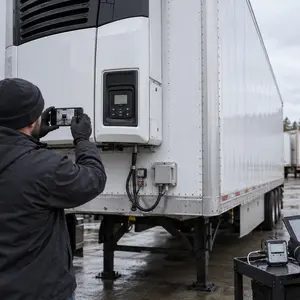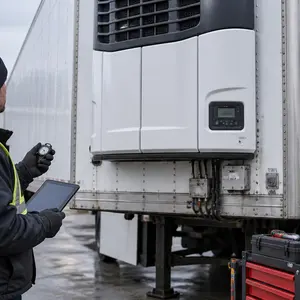


A trailer refrigeration unit that never reaches stable operation needs a clear first branch. The controller may remain dark, may power up but reject the start request, may command a start without cranking, or may crank without the engine continuing to run. These observations direct different tests for Thermo King and Carrier equipment.
A no-start is not the same as a unit that runs and later shuts down. It also differs from a running unit that cannot hold cargo temperature. Record the condition before repeated power cycles, jump starts or alarm clearing change the original evidence.
Identify the refrigeration unit and controller
Send the trailer number, unit make, model and serial information with a photograph of the complete front housing and controller. Controller families and start sequences differ across models and revisions. A procedure, alarm definition or test value from another family cannot be assumed to apply.
The refrigeration unit belongs high on the trailer front wall. A small enclosure on the tractor frame is an APU for cab comfort and auxiliary power. Photographing the correct asset prevents a cargo refrigeration no-start from being routed to the tractor system.
Record what happens after the first start request
Describe the sequence in ordinary terms: screen dark, screen wakes, pretrip begins, relay or starter clicks, engine cranks, engine catches briefly, or controller returns to an alarm state. Add approximate duration and note whether the behavior changes on a second request.
Capture a short video when timing or sound is difficult to describe. Stay clear of belts, fans and the trailer front. Transport refrigeration equipment can start automatically after conditions or controls change.
Branch a dark controller from a powered no-start
A dark display moves the first checks toward applicable battery supply, cables, grounds, protection devices, controller power and visible connection condition. It does not prove the controller itself failed. Measurements follow the wiring and isolation information for the identified unit.
A powered controller shows that some electrical supply is present. It does not confirm that the starting circuit, engine controls or every protected output receives the required voltage under load. Preserve the displayed state before disconnecting power.
Preserve active alarms and event history
Photograph the full display, active alarms and stored history before clearing anything. Include surrounding messages, operating mode and the controller family. A cropped number removes context that may distinguish an old event from the condition blocking the current start.
Alarm meaning and response are model-specific. A code records what the controller detected and points toward a diagnostic path; it does not automatically identify the part to replace. Service testing must confirm the present condition.
Test the battery and connections under starting load
An open-circuit battery reading can look ordinary while voltage falls during a start request. The technician measures the applicable load response and checks terminals, cables, grounds, protection points, corrosion and heat evidence. Connection cleaning or tightening is documented with the condition found.
Repeated jump starting can hide a supply problem, overheat a poor connection and erase useful controller evidence. External power is used only through the applicable procedure and safe connection points. Sparks, swollen batteries or hot cables require the attempt to stop.
Separate no-crank from crank-without-start
No-crank means the controller accepts or appears to accept a request, but the engine does not turn. The service path can include command state, interlocks, starting-circuit supply, starter control and mechanical condition. A click alone does not select the failed component.
Crank-without-start supplies different evidence. Record crank speed and consistency, whether combustion begins briefly, smoke or odor from a safe distance, controller changes and the time before the attempt ends. Do not continue cranking beyond the equipment procedure.
Confirm fuel evidence without unsafe line opening
Check actual fuel quantity, recent fueling, visible tank and line condition, accessible filter area and any leakage or contamination evidence. A dashboard-style gauge or visual tank level does not prove usable fuel reaches the engine.
Priming, bleeding, pressure tests and filter access are performed for the exact model in a controlled state. Do not loosen fuel fittings beside traffic, cargo work or an ignition source. Fuel leakage or strong vapor stops further start attempts.
Check accessible air and mechanical condition
With automatic start disabled according to the service procedure, inspect accessible intake condition, guards, belt area, mounting and signs of impact or debris. Main covers remain closed during driver intake. Internal inspection belongs to trained service with controlled isolation.
A worn-looking belt, dirty area or fluid trace may be relevant, secondary or unrelated. It becomes a repair finding only when model-specific inspection and operating evidence support it. Visual similarity does not establish part fitment.
Include temperature and operating context
Record ambient weather, setpoint, controller mode, cargo status, recent door activity and how long the unit had been off. Cold soak, heat, moisture and a recent operating transition can affect how an intermittent no-start presents.
Those conditions guide a controlled reproduction under comparable weather and operating state; they do not excuse the failure or assign one universal cause. If cargo temperature is at risk, notify the authorized cargo contact while diagnosis proceeds. Service findings do not replace cargo-disposition authority.
Report recent service and configuration changes
Provide the date and scope of recent battery, starter, fuel, engine, controller, sensor or refrigeration work. State the observed result and how long the unit operated afterward. A recently installed part is evidence to inspect, not automatic proof of responsibility.
Connector seating, cable routing, configuration and verification can be checked against the correct documentation. When records are missing, photographs of the undisturbed condition help establish what changed before the no-start.
Stop attempts when the condition is unsafe
Stop when there is smoke, electrical heating, fuel leakage, mechanical impact, damaged rotating equipment or a controller instruction requiring shutdown. Keep personnel away from the trailer front and prevent another automatic request until qualified service controls the hazard.
Repeated identical attempts without new measurements drain the battery and alter the condition. One recorded sequence, complete controller history and a reliable contact are more useful than many undocumented cycles.
Choose field diagnosis or shop testing
Mobile service can begin with asset identification, controller evidence, accessible electrical measurements, exterior inspection and a safe start observation. The location needs legal parking, property permission and clearance between the tractor and trailer front.
A shop may be required for guarded access, extended electrical isolation, load equipment, fuel-system tests or a mechanical condition that cannot be evaluated safely outside. The reason for relocation and the unresolved test are recorded.
Information to provide before dispatch
- Asset: trailer number, make, model, serial information and full controller photograph.
- First request: display state, prestart activity, click, crank and any brief engine response.
- Alarm evidence: complete active and stored events before clearing.
- Conditions: ambient weather, time since last run, mode, setpoint and cargo status.
- Physical evidence: sound, odor, smoke, leakage, heating or visible damage from a safe position.
- Recent work: system serviced, date and reported result.
- Location: Illinois road or facility, direction of travel, parking position and access contact.
Do not open the unit to complete dispatch intake. Accurate external evidence allows the technician to bring the correct references and testing equipment.
Verify a complete and stable start
After authorized repair, verification begins with the same controller state and operating request. Record controller wake, prestart sequence, cranking behavior, successful engine operation and stable runtime through the relevant operating transition. Confirm that the original blocking condition and alarm state do not immediately return.
If the no-start was intermittent, the closeout states the observation duration, ambient condition, electrical state and time since the last successful run. One brief successful start is not presented as proof of every future cycle. Any remaining warm, cold-soak or moisture-related condition is identified for follow-up.
Reefer no-start service across Illinois
Chicago is the service base, with Thermo King and Carrier no-start diagnosis coordinated across Illinois according to location, safe access, cargo situation and required test conditions. Highway, truck-stop, fleet-yard, dock and distribution-center calls require precise placement and site contact information.
Planned fleet assignments in nearby states, including Indiana, may be arranged after travel, access and scope are agreed. That planned work does not create automatic emergency coverage outside Illinois or a guaranteed arrival time.