

A trailer refrigeration unit may eventually start, run for several minutes or hours, shut down and then refuse the next start request. That pattern is different from a unit that never responds at all. Accurate reefer diagnosis preserves the order of events, the controller state and the conditions surrounding each attempt before a component is selected.
This service scope covers Thermo King and Carrier transport refrigeration units that crank reluctantly, require repeated attempts, stop after operating or fail to restart after a shutdown. It does not replace cargo-temperature emergency decisions, a brand-specific alarm-code procedure or a general no-start page. Those related needs remain separate so the work order begins with the actual failure mode.
Separate hard starting from a complete no-start
A hard-start complaint means the unit begins some part of its starting sequence but reaches stable operation slowly or inconsistently. Record whether the controller wakes, a prestart check begins, the starter engages, the engine turns, combustion begins and the unit settles into normal running. The exact sequence varies by model and operating state, so ordinary language is more useful than an assumed technical label.
A complete no-start has no successful operating period to compare. A restart failure follows an earlier run or shutdown and may depend on temperature, time, electrical recovery or an active protection state. Reporting which of these occurred prevents a technician from testing only the first cold start and missing the event that disabled the trailer.
Build a timeline before another attempt
Write down when the first request was made, how many attempts occurred, how long each attempt lasted, when the unit finally ran and how much time passed before it stopped. Add the delay before the next restart request. Approximate times are still useful when the record identifies them as estimates and keeps them separate from controller data.
Include ambient temperature, recent trailer operation, whether the unit had been sitting overnight, current operating mode, cargo condition and any recent fuel or electrical work. A failure that appears only after a warm run has a different diagnostic path from one that appears after a long cold soak or immediately after service.
Preserve the complete controller and alarm record
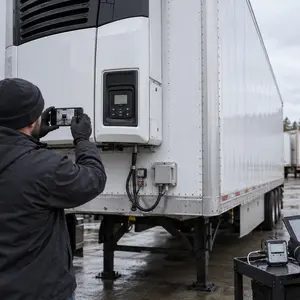
Photograph the entire Thermo King or Carrier display with the unit number visible in a separate frame. Capture active alarms, stored history, operating mode and any plain-language status presented by the controller. Do this before clearing alarms, disconnecting power or changing the setpoint.
An alarm is evidence of what the control system detected; it is not automatically the name of the failed part. The same shutdown state can be reached through wiring, sensor, supply, mechanical or operating-condition problems. Code meaning and test sequence must come from the correct model and controller documentation.
Describe sound and movement without opening the unit
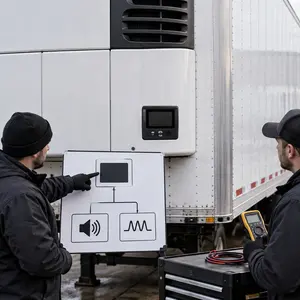
From a safe position, note whether there is silence, a single click, repeated clicking, normal cranking, unusually slow cranking or an attempt that catches and immediately stops. Record abnormal vibration, impact, squeal, grinding or a sudden change in fan sound. A short video can preserve timing that a text note misses.
Do not reach into belts, fans or an automatic-start enclosure to identify a sound. Trailer refrigeration units can start without another warning once controls request operation. Guards and doors remain in place during driver intake; internal observation belongs to a controlled service procedure.
Check the electrical starting supply under load
A battery can show an ordinary open-circuit reading and still fall outside the required behavior during a start request. Diagnosis measures the applicable voltage response under load and inspects terminals, cables, grounds, protection devices and signs of heating or corrosion. Test limits and connection points are model-specific.
Loose or resistive connections can create intermittent behavior that changes with vibration, moisture or temperature. The technician records the condition before cleaning or tightening so the repair has an identified basis. Jump-starting repeatedly can erase useful evidence, overheat a connection or introduce another fault.
Confirm fuel quantity, quality and delivery evidence
The trailer fuel source, visible lines and accessible filter area are inspected for actual quantity, contamination evidence, leakage, damage and recent disturbance. A gauge reading alone does not confirm that usable fuel reaches the engine. The service record should note whether the complaint followed fueling, filter work, extended storage or a very low tank condition.
Priming, bleeding, pressure checks and component access follow the procedure for the identified unit. Do not loosen a fuel fitting or bypass a protection device beside cargo, traffic or an ignition source. If fuel leakage, strong vapor or damaged plumbing is present, repeated starts stop until the area is made safe.
Inspect the accessible air path and mechanical drive
With the unit safely disabled, the technician checks accessible intake condition, filter restriction evidence, belt condition, mounting, guards and signs of contact or debris. A photograph of the undisturbed condition is useful when material has shifted into an intake or belt area.
Visible wear does not prove that it caused the shutdown. Belt dust, a damaged guard, oil residue or a loaded filter may be relevant, secondary or unrelated. The finding is connected to measured behavior and the manufacturer procedure before a replacement is authorized.
Distinguish a commanded shutdown from an engine stall
A controller may stop the engine because it detected a condition that requires protection, because the operating cycle ended or because another input changed. An engine can also lose stable operation before the controller records the result. The display sequence, sound, runtime data and alarm history help separate these paths.
Record whether cooling demand remained, whether fans or display stayed active and what status appeared immediately after the engine stopped. Avoid describing every stop as a stall. The distinction matters because a controlled shutdown, loss of combustion and loss of electrical power do not lead to the same tests.
Observe what changes before the repeated shutdown
When safe operation permits, monitor the unit from startup through the point at which the reported shutdown normally occurs. Record elapsed time, mode, controller state, supply voltage, visible airflow behavior, unusual sound and any permitted temperature or pressure observations. The test ends if a safety concern appears.
A shutdown tied to a transition can be especially useful: initial startup, a change between operating modes, rising engine temperature, increased refrigeration load or the next automatic cycle. The article does not assign a universal cause to any transition. It defines the evidence needed for the correct service information to be applied.
Compare cold start, warm restart and soak behavior
Some failures appear after the engine and electrical components have operated long enough to warm. Others appear after an overnight cold soak, rain, wash exposure or a long period without operation. State which condition was present and how long the unit had been off before each restart attempt.
If the unit starts normally after cooling down, the successful cold restart does not close the original complaint. The technician needs a controlled observation period that reaches the earlier failure window when practical. The final record states the runtime and soak time and avoids claiming correction without reproduction.
Keep refrigeration load separate from starting evidence
Setpoint, return-air temperature, operating mode and recent door activity influence the work the unit is asked to perform. They do not, by themselves, identify why an engine cranks slowly or why the controller loses power. Record load conditions so the shutdown can be reproduced without turning cargo temperature into a guessed starting-system diagnosis.
If cargo temperature is at risk, the fleet or cargo responsible party makes the operational decision while service diagnosis proceeds. Repair personnel can report unit behavior and measured conditions, but they do not replace shipper, carrier or receiver authority over cargo disposition.
Use recent repair history as evidence, not a verdict
Provide the date and scope of recent battery, starter, charging, fuel, engine, controller, sensor or refrigeration work. Include the observed result and how long the unit operated afterward. A new part does not prove that the same circuit is correct, and a recent repair is not automatically responsible for the new symptom.
Installation condition, connector seating, configuration and verification results can be checked without blaming a component by age. When records are unavailable, photographs and a precise sequence help reconstruct what changed. Parts are matched by model and serial information, with visual similarity never used as fitment proof.
Know when repeated restarts must stop
Stop further attempts when there is smoke, fuel leakage, electrical heating, damaged rotating equipment, mechanical impact, an unsafe exhaust condition or a controller instruction that requires shutdown. Move people away from the hazard and follow the site, fleet and emergency process appropriate to the location.
Repeated cycling is also unhelpful when each attempt produces the same alarm without new evidence. It can drain the battery, heat a connection and change the original condition. One complete recorded sequence is more valuable than many undocumented attempts.
Choose field diagnosis or controlled shop access
Field service can begin with asset identification, controller history, accessible electrical measurements, visual inspection and safe operating observation. The location must provide legal parking, clearance at the trailer front, permission from the property and enough separation from traffic and cargo activity.
Shop conditions may be required for guarded component access, extended runtime, exhaust control, refrigeration testing, load equipment or an intermittent failure that cannot be observed safely outdoors. Routing the unit to a shop is a service decision based on access and test requirements, not an admission that the initial visit failed.
Information to send with the service request
- Asset: tractor and trailer numbers, unit make, model, serial information and a clear controller photograph.
- Sequence: first request, prestart or crank behavior, successful runtime, shutdown and every restart attempt.
- Timing: approximate duration of cranking, running and off periods.
- Controller evidence: complete active alarm and history images before clearing.
- Conditions: ambient weather, operating mode, setpoint, cargo status and recent door activity.
- Physical evidence: sound, vibration, odor, smoke, leakage, heating or visible damage from a safe distance.
- Recent work: affected system, date and observed result.
- Location: Illinois road, facility or yard location, travel direction, access contact and safe parking instructions.
Avoid sending only a cropped code number or “keeps dying.” The sequence and context determine which technician, equipment and service conditions are needed.
Verify more than one successful start
After authorized work, repeat the operating condition that produced the complaint. Verification records controller state, starting behavior, stable runtime, shutdown behavior and the next restart when that sequence can be performed safely. The observation window should be long enough to address the original timing.
If the failure was intermittent and did not return, the closeout states what was tested, for how long and under which conditions. It separates confirmed correction from a condition that still needs monitoring or a planned follow-up. A cleared alarm and one short start are not presented as proof of every operating cycle.
Reefer hard-start and shutdown diagnosis in Illinois
Chicago is the service base, with trailer reefer diagnosis coordinated across Illinois according to location, safe access, unit condition and the time required to reproduce the event. Highway, truck-stop, fleet-yard, loading-dock and distribution-center calls each require accurate access information before dispatch.
Planned fleet assignments in nearby states, including Indiana, may be arranged when travel, access and scope are agreed beforehand. That planned work does not create automatic emergency coverage outside Illinois or a guaranteed arrival time for every location.