

I-90 and I-94 carry refrigerated trailers through several very different Illinois operating environments. A westbound call can be on the Jane Addams Memorial Tollway near Rockford, on a suburban approach to O'Hare or on the combined Kennedy Expressway in Chicago. An I-94 report may refer to a shared segment, a branch or another expressway connection, so the route number by itself does not establish the service location.
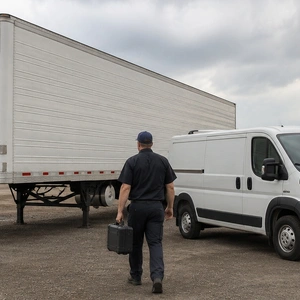
Ustarshah coordinates mobile work on Thermo King and Carrier trailer refrigeration units at Illinois locations where safe access is available. Illinois is the primary service area. Arrival and field-repair scope depend on the confirmed position, traffic conditions, legal parking, technician availability, unit identity and the fault found at the trailer.
Name the roadway segment, not only the interstate
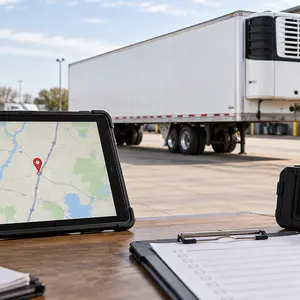
Start with the route number and direction. Add the roadway name when the driver knows it, then provide the nearest exit, milepost, cross street, tollway plaza or facility entrance. A live location pin should support those details instead of replacing them.
This matters where route designations overlap or separate. “I-90 westbound” near a complex junction can leave several access questions unanswered, while “westbound Jane Addams, past the named exit, parked in the customer lot reached from the north entrance” gives dispatch a position that can be verified.
Inbound and outbound language needs a compass direction
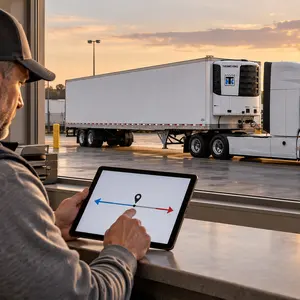
Chicago-area drivers often use inbound and outbound, but those words can change meaning across branches and dispatch teams. Include eastbound, westbound, northbound or southbound as shown by the driver's navigation display or last reliable route sign. Then identify the last passed exit and the next visible destination sign without trying to type while moving.
Stop first. A parked driver can send a pin, photographs and written access notes accurately; a moving driver should concentrate on reaching a lawful stopping place. Dispatch can begin organizing the call after the vehicle is secure.
Tollway, suburban and urban access are separate service problems
The Jane Addams section of I-90 crosses a long corridor between the Rockford area and the Chicago region. Closer to O'Hare and on the I-90/I-94 urban approach, interchange density, traffic and restricted stopping space become more influential. The same mileage can therefore represent very different travel and access conditions.
Current incidents, lane restrictions and construction must be checked through official traveler information at dispatch time. Saved closure details age quickly. No estimate should be based on an old detour, a screenshot from a previous trip or an assumption that a ramp is open.
A shoulder is not a normal reefer service bay
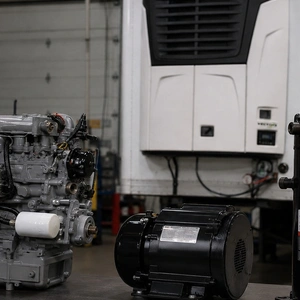
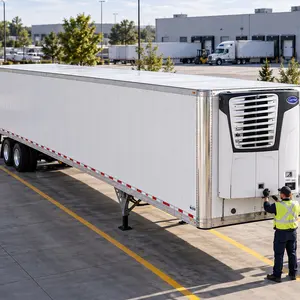
The refrigeration unit occupies the trailer's front wall above the tractor frame. Inspection may require standing in the tractor-trailer gap, opening an exterior service panel or placing equipment on the pavement. Those tasks need clearance from moving traffic and a stable working surface.
If the tractor-trailer can move safely, the fleet may direct it to an authorized truck parking area, customer yard or service location. A toll plaza, narrow ramp gore and travel lane are not service locations. When the vehicle cannot move, traffic control, towing and law-enforcement direction are separate from refrigeration repair and must be handled by the responsible parties.
Property access must be confirmed before the truck arrives
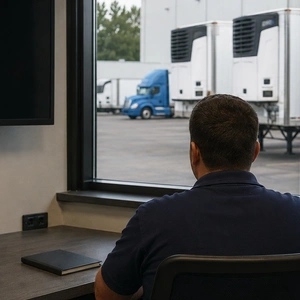
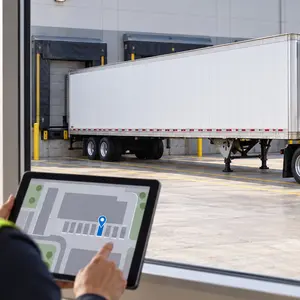
Urban and suburban parking areas may have gate controls, dock schedules, low-clearance routes or rules that keep outside service vehicles from entering without approval. Send the facility name, exact entrance, guard instructions and on-site contact. State whether the trailer is attached to the tractor and whether another vehicle blocks the front wall.
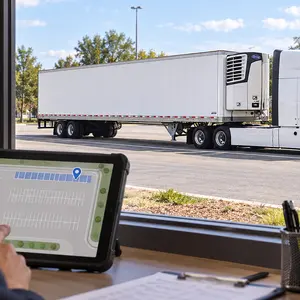
A location pin at the center of a large freight property is incomplete. Dispatch also needs a yard row, dock number or landmark that can be understood after the technician passes the gate. Agree on any required trailer move in advance.
Preserve controller evidence before resets
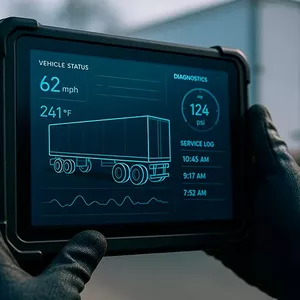
Photograph the controller display, active alarm indication and current temperature before clearing codes or cycling power. Report the setpoint, whether the reading is rising or falling, and whether the unit is running, attempting to start, repeatedly shutting down or entirely unresponsive. The sequence is often more useful than a single number.
Include the approximate time of the first abnormal event. Door openings, loading, standby operation, fuel stops, recent repair and previous restart attempts add context. None of those details proves which component failed, but they keep the initial tests tied to the actual history.
Thermo King and Carrier identification controls the next step
Send the manufacturer, model, serial number, controller family and trailer asset number. Thermo King and Carrier units share broad refrigeration functions, yet controller menus, alarm definitions, electrical architecture and service procedures differ by platform. Similar exterior size does not make parts interchangeable.
Use one photograph of the complete front-wall installation and a closer image of the factory data plate. The full view confirms the housing and installation; the plate supports technical lookup and parts matching. Drivers should not remove service covers beside traffic to obtain internal photographs.
Cooling complaints need operating history
For temperature loss, provide the requested setpoint, displayed return-air temperature, last stable reading and time trend. Add the operating mode and recent door or loading history if known. A loaded trailer that warms after repeated door openings presents a different test history from an empty trailer that cannot pull down.
Do not convert that intake into a remote refrigerant or compressor diagnosis. Airflow restriction, sensor input, control state, defrost behavior, load condition and refrigeration faults can produce overlapping symptoms. Measurements at the identified unit determine the repair path.
No-start and shutdown reports must remain distinct
A unit that never cranks, one that cranks without starting and one that runs before shutting down are different complaints. Record which occurred. State whether shore power or standby was involved and how many restart attempts took place.
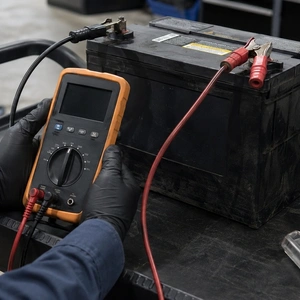
Repeated cranking can reduce available battery capacity, while repeated resets can disturb alarm history. Preserve the first useful evidence and stop adding variables. Smoke, leaking fuel, burning odor or another immediate hazard takes priority over controller photographs and requires the appropriate safety response.
The first visit may end with repair or a defined next scope
At a protected location, the technician can inspect accessible systems, review controller history and take measurements that match the complaint. Some starting, charging, fuel, control, sensor or airflow work may be completed in the field when the confirmed part, tools and working conditions are available.
Major component access, sealed-system contamination concerns, complex fabrication or an intermittent fault needing extended operation may require a shop. Mobile diagnosis still has value when it documents the finding, the unit's current ability to run and the equipment required for the next stage.
Release testing follows the original failure
A no-start repair may call for repeated starts and charging checks. A cooling complaint needs an appropriate observation of controller inputs, airflow and temperature movement. One moment of operation cannot verify every repair.
The closeout should connect the stated complaint, evidence, confirmed finding, work performed and final test. It should also identify any limitation or scheduled follow-up. The fleet then has a service record for its trailer decision without a promise about cargo condition.
I-90 and I-94 dispatch checklist
- Route: I-90 or I-94, roadway name, compass direction, last exit or milepost and location pin.
- Parking: lawful position with stable pavement and front-wall clearance.
- Property: entrance, gate process, dock or row, on-site contact and access authorization.
- Unit: Thermo King or Carrier, exact model, complete serial number, controller family, trailer asset ID and exterior photographs.
- Condition: current operating state, trend and alarm evidence.
- History: first event time, operating mode, door activity, every restart attempt, recent repair, fuel stop and standby use when known.
Send the information after the vehicle is parked. It does not guarantee that every failure can be repaired at the first location, but it lets dispatch separate a route problem, an access problem and an equipment problem before travel begins.
Illinois coverage and planned fleet assignments
Calls on I-90 and I-94 are evaluated at their actual Illinois location. The combined title does not promise identical response anywhere on either interstate, and it does not extend emergency coverage across state lines. Route, access and workload are checked for each request.
Planned work for fleets in nearby states, including Indiana, may be arranged separately when travel, property access and service scope are agreed in advance. That scheduled assignment is different from an automatic highway-response promise.