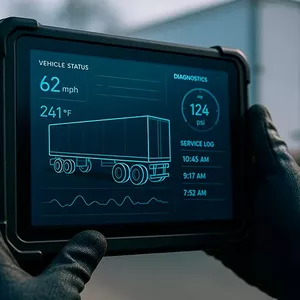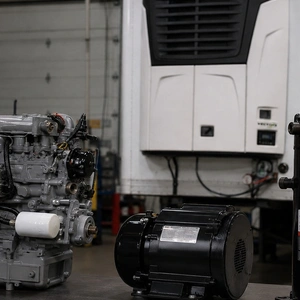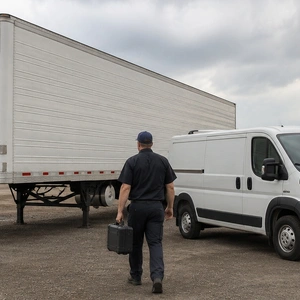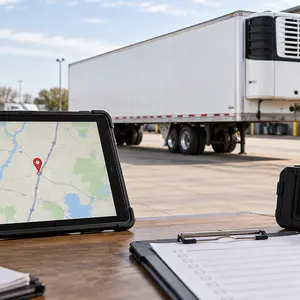


A reefer electrical complaint can begin as a dead controller, a slow crank, a unit that starts only after a boost, a charging warning, or a shutdown that returns after vibration and runtime. Those symptoms share part of the same electrical path, but they do not identify the same failed component. Mobile diagnosis is used to separate the power source, connections, charging circuit, starting circuit, controller supply, and the load that was present when the problem appeared.
This service applies to refrigerated trailer and truck units at safe roadside stops, loading docks, and fleet yards across Illinois. Work in Indiana or another state is scheduled by agreement for fleet assignments; it is not presented as a fixed local response area. The first dispatch decision depends on exact location, safe access, unit identification, load status, and the current temperature trend.
Separate No Power, No Crank, and Crank-Without-Start
“The reefer will not start” is not a complete electrical diagnosis. A blank controller points first toward available power, protection devices, connections, and controller supply. A powered controller with no crank moves the test path toward the start request, interlocks, starter circuit, and voltage behavior under load. Normal cranking without engine start moves the job beyond a battery-only assumption and into fuel, control, and engine evidence.
The technician needs to see what the unit does before cables are disturbed or codes are cleared. Repeated boosting can temporarily change the symptom without explaining the cause. The useful evidence is the open-circuit condition, the voltage response during a start attempt, connection condition, charging behavior after start, controller history, and whether the fault returns under the same operating sequence.
Battery Condition Is More Than a Static Voltage Reading
A static reading can show that voltage is present, but it does not prove that the battery and its connections can support cranking and control loads. Diagnosis compares the resting condition with behavior during the start request. A sharp drop may come from a weak battery, resistance at a connection, a high-current starting problem, or a combination of those conditions.
Battery age by itself is not a repair instruction. Terminals, cable ends, grounds, mounting, contamination, and signs of heat or movement all matter. If external power or a boost is used for testing, the result must still be checked after that support is removed. A unit that runs only while assisted has not passed a release check.
Charging Evidence Must Be Checked Under Operation
Once the unit starts, the next question is whether the electrical system can restore and maintain the battery while normal loads are active. Charging diagnosis considers measured output, belt and drive condition where applicable, wiring and ground integrity, controller indications, and changes as the unit moves through its operating sequence.
A charging warning does not automatically condemn an alternator. A loose or damaged connection, poor ground, drive concern, protection device, or control issue can produce similar evidence. Replacement is justified only after the failed path is confirmed and the surrounding circuit is able to support the new component.
Intermittent Shutdowns Need Vibration and Runtime Context
Some electrical faults appear only after heat, vibration, moisture, or time in operation. A unit may start normally in a quiet yard and shut down later on the lane. That pattern makes connector retention, cable movement, harness routing, ground quality, and repeated controller history more important than a single successful restart.
Field testing can establish whether the fault is visible and safely accessible. If the complaint needs extended runtime, controlled load transitions, harness access, or deeper disassembly, the correct result of the mobile visit may be a documented move to the shop rather than an uncertain roadside parts change.
What Mobile Electrical Service Can and Cannot Do
A safe field location may support battery and cable testing, connection correction, accessible protection-device checks, charging assessment, starter-circuit diagnosis, controller-power verification, and replacement of a confirmed serviceable component. The exact scope depends on the unit, access, weather, traffic exposure, and the equipment needed to verify the result.
Field work is not appropriate when the trailer position is unsafe, energized or high-current work cannot be isolated correctly, the required component is inaccessible, or the repair needs shop equipment and extended validation. In those cases, the technician records the evidence already established and routes the unit to controlled service. That avoids repeating intake and keeps the next step tied to the same fault history.
Information That Improves the First Diagnostic Pass
- Exact unit make, model, controller family, and serial information when available.
- Whether the controller is blank, the engine does not crank, or the engine cranks without starting.
- Any active and recent alarms before they are cleared.
- Whether a boost or external power changed the symptom.
- When the problem appears: first start, after runtime, after shutdown, during standby, or after road vibration.
- Current box temperature trend, setpoint, load status, and safe access instructions.
These details do not replace testing. They keep no-power, starting, charging, and controller concerns from being mixed together before the technician reaches the unit.
Release Requires More Than One Successful Start
After a repair, the electrical path is checked through a relevant operating sequence. The unit should start without temporary support, maintain control power, show stable charging behavior, and remain free of the original symptom during the available verification period. The completed work and any unresolved condition should be recorded against the identified unit.
If the result cannot be verified in the field, the service record should say so plainly and define the next controlled test. A clear escalation is more useful to a fleet than treating a temporary restart as proof that an intermittent electrical fault is closed.