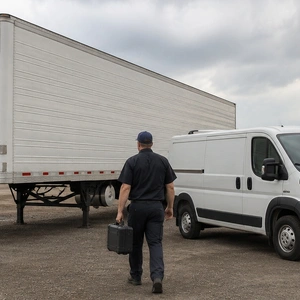


Several failed reefers may wait in one fleet yard. The first may not start, the second may show a recurring alarm, and another may be needed for dispatch before the others. Treating different complaints as one identical job hides the evidence, access requirements, parts decisions and operating priorities that a technician needs to plan useful corrective work for every listed trailer.
Ustarshah coordinates corrective service for Thermo King and Carrier trailer refrigeration units at fleet locations across Illinois. Each visit begins with an affected-asset list, a responsible fleet contact and a safe work position. Planned preventive maintenance remains a separate program with its own schedule and scope.
Start with an exception list, not the entire yard inventory
Identify the trailers that have an active fault or unresolved operating complaint. For each one, send the asset number, refrigeration-unit manufacturer and model, yard position, reported symptom and current dispatch status. Do not add unaffected trailers merely because they are parked nearby.
A short, accurate exception list helps the technician prepare for the faults that actually need attention. If another unit is added after the visit is scheduled, report it before arrival so its access, evidence and likely service scope can be evaluated.
Set the operational priority before the technician arrives
The fleet controls which trailer matters first. A loaded unit with unstable temperature, an assigned trailer due to leave soon and an empty unassigned trailer do not carry the same operational priority. Name the starting trailer.
Priority does not predict repair time or prove which fault is most serious. It tells the technician where to begin when several known problems are waiting. A new safety concern or a different operating condition may still require the sequence to be reviewed on site.
Map every trailer to an exact yard position
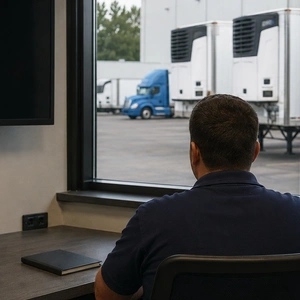
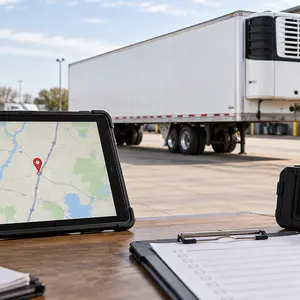
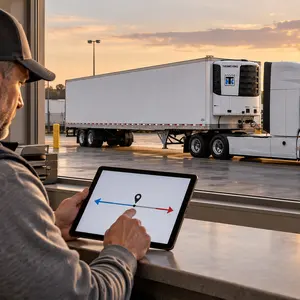
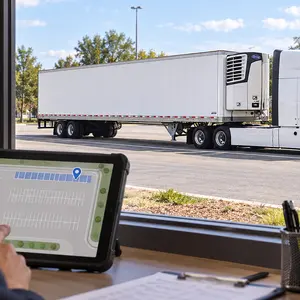
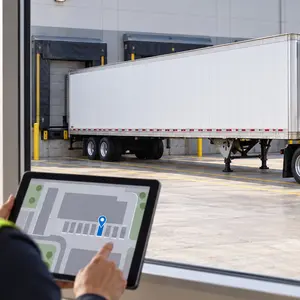
Send the facility address, approved truck entrance, gate process and a location pin. Then identify each trailer by row, marked space, landmark or other position used by the yard. A list of asset numbers without their locations can turn a service window into a search.
Update the contact if a yard tractor moves a listed trailer. The technician should not assume that a unit remains in yesterday's row or follow an unverified asset number on a neighboring trailer. Position and identity are confirmed together before work begins.
Assign movement authority and keys
Fleet personnel decide who may open, connect, disconnect or reposition a trailer. Provide the yard contact who controls those actions and any controller keys needed for the listed units. The mobile technician does not take over the property's trailer-movement process.
If the tractor frame, fence, another trailer or parked equipment blocks the front wall, the fleet may need to create clearance. Movement happens under fleet procedures and only by authorized personnel. Repair starts after the trailer is secure in the agreed service position.
Create one controlled work zone at a time
Rows that remain active for yard tractors, drivers or pedestrians cannot double as an unrestricted repair area. Select a stable surface with front-wall access, suitable lighting and a boundary that other yard traffic can respect. Cones identify the immediate work space but do not replace site traffic control.
When several trailers are listed, bringing each unit to the same approved service position can reduce changing hazards. The fleet determines whether that workflow fits its operations. No trailer should be staged where it blocks emergency access, gate movement or an active dispatch lane.
Preserve the complaint and controller evidence for each unit
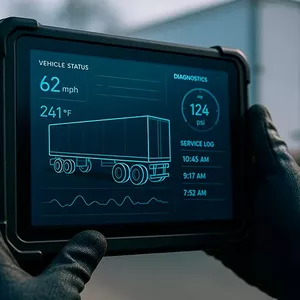
Record setpoint, observed temperature trend, operating mode, alarm display and the time the problem appeared. Note whether the unit starts, stays running, shuts down, cycles unexpectedly or runs without the expected temperature response. Save photographs before alarms are cleared or power is cycled.
Keep evidence attached to the correct asset number. Screenshots and verbal reports lose value when they cannot be matched to a specific Thermo King or Carrier unit. Report every restart or temporary action already attempted by the driver or yard staff.
Confirm exact Thermo King and Carrier identification
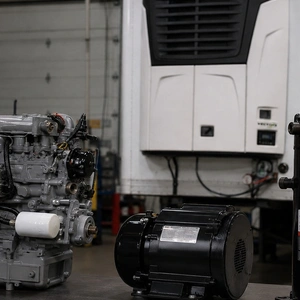
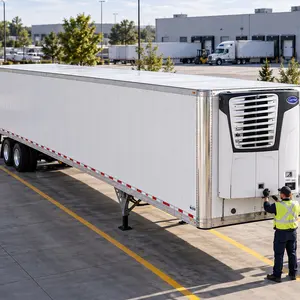
Photograph the complete front-wall installation and the data plate with model and serial number. Add the controller family and the fleet's trailer identifier. These details support the correct technical information and parts preparation without assuming that two similar housings contain the same configuration.
Drivers and yard personnel should leave service covers closed during intake. An exterior photograph is for identity, mounting and access context; it is not a substitute for diagnosis. Parts are selected only after the relevant fault and component requirements are confirmed.
Multiple units still require individual diagnosis
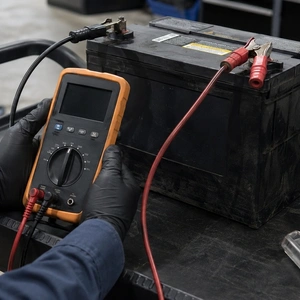
A batch visit does not turn different symptoms into a common failure. One unit may need electrical testing, another may have a control or sensor problem, and a third may require evaluation of starting, fuel, airflow or refrigeration performance. Each path follows evidence from that asset.
Shared age, route or parking location can be useful history, but it does not prove a shared component fault. The technician records findings per trailer and avoids carrying an unverified conclusion from the first unit to the next one.
Separate corrective repair from preventive maintenance
Fleet yard repair concerns reported failures and corrective work. A preventive maintenance visit follows an interval, equipment list and defined maintenance checklist even when no unit has failed. Combining the two without advance scope can leave both the repair queue and planned maintenance incomplete.
If inspection reveals overdue maintenance, document the finding, the affected asset and why it falls outside the approved repair so the fleet can route it through a separate maintenance decision without losing the original corrective-work status. A fault discovered during scheduled PM becomes corrective work. The fleet then decides whether it is authorized now or scheduled for follow-up.
Field completion depends on the confirmed fault
Accessible diagnostic and corrective work may be completed in an approved yard position when the required tools, conditions and confirmed parts are available. Major component access, fabrication, contamination concerns or failures needing extended controlled observation may require a shop environment.
Moving a unit to a shop is not a failed yard visit when the field findings define the necessary next step. The closeout should state what was verified, what remains unresolved and what conditions are required for further work. No blanket same-day completion promise applies to a multi-unit queue.
Maintain a separate status for every trailer
Each asset receives its own reported complaint, finding, work record and final operating observation. Status may be complete, temporarily restored, waiting for an approved part, referred for controlled repair or pending more diagnosis. A single fleet summary should never erase those individual distinctions.
The designated contact confirms which units may return to dispatch and which remain held. Cargo decisions, load assignment and route release stay with the responsible fleet parties. Reefer repair reporting describes equipment condition rather than certifying product condition.
Fleet yard reefer repair intake checklist
- Facility: full address, truck entrance, gate process and on-site contact.
- Assets: affected trailer numbers and exact yard positions.
- Priority: the fleet-assigned starting sequence, current dispatch state for every listed trailer and the named person authorized to change the order.
- Access: clearance, movement authority, keys and traffic boundary.
- Units: Thermo King or Carrier manufacturer, exact model, serial number, controller family, trailer asset ID and a readable data-plate photograph.
- Evidence: symptom, alarm image, setpoint, trend, event time and restarts.
Use one format. Mark every change before arrival so dispatch retains an accurate count, a current yard position and the correct complaint for each individual trailer.
Illinois fleet locations and planned travel
Illinois is the primary area. For each fleet yard reefer repair request, access requirements, safe work positions, the affected-unit count and technician availability are evaluated against the actual property and the operating window supplied by the fleet. Response timing cannot be identical statewide.
Planned assignments at fleet locations in nearby states, including Indiana, may be arranged when travel, access and work scope are agreed beforehand. They are coordinated fleet visits and do not create automatic emergency coverage outside Illinois.
Chicago-area yards and fleet properties elsewhere in Illinois need unit-level work records even when several trailers share one visit.