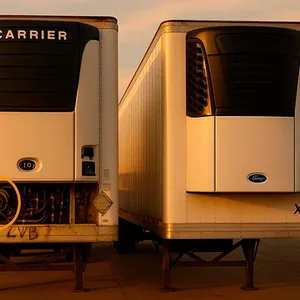


Carrier Vector 8600MT, 8611MT, 8800MT, and 8811MT are multi-temperature trailer refrigeration units used on 53’ refrigerated trailers carrying frozen, chilled, and protected freight in the same load. We provide Carrier Vector multi-temp repair and service in Chicago and across Illinois for fleets dealing with one zone running warm, weak temperature separation between compartments, slow recovery after stop activity, unstable response in a specific section of the trailer, and repeat failures that return under a different complaint on the next lane.
Work here stays limited to Carrier Vector multi-temp trailer units. Carrier Vector 8500 and 8700 single-temp models, Carrier X4 belt-driven trailer units, alarm-code lookup, reset procedures, preventive maintenance scheduling, and Vector 8100 or eCool systems are handled separately. The scope here is commercial repair for multi-temp trailer reefer service, not a manual, not a troubleshooting guide, and not a code reference.
Carrier Vector Multi-Temp Repair for Distribution Fleets and Multi-Compartment Trailer Loads
Multi-temp trailer reefer repair starts from a different service reality than single-temp work. One box with one setpoint is easier to judge. A divided trailer moving mixed-temperature freight is not. One compartment can stay close to target while another falls behind. The unit can continue running while product protection across the trailer is already compromised. A short pull-down at the dock can look acceptable and still tell almost nothing about how the trailer will behave after a dozen door openings, standby transitions, short unload windows, and stop-and-go route pressure.
That is why fleets often describe these cases with symptoms that sound broad at first. One zone warm. Rear section slow to recover. Temperature split getting soft. Unit running but not protecting the load. Those complaints are useful, but they do not define the repair path by themselves. On Carrier Vector multi-temp equipment, the real service question is whether each section of the trailer can hold its assigned role under normal operating conditions, not whether the unit can produce one brief period of acceptable behavior when the demands are light.
For distribution fleets, that distinction matters immediately. A multi-temp reefer that needs constant watching from dispatch is already costing time, labor, and confidence, even before the trailer reaches a full shutdown event. The repair has to restore route-ready compartment control, not just activity at the unit.
Why Carrier Vector Multi-Temp Units Need a Different Repair Approach
Carrier built the Vector platform around E-Drive architecture with a direct-driven 21 kVA generator powering an all-electric refrigeration system. That platform identity changes the way multi-temp service cases are read. A warm zone may not point to the same kind of failure path fleets expect on simpler trailer units. Controls behavior, electrical behavior, refrigeration behavior, and compartment behavior stay tied together much longer in the diagnosis, especially once the trailer starts showing unstable response across more than one temperature space.
The model family also divides into two layouts with different service implications. Vector 8600MT and 8800MT sit on the remote-evaporator multi-compartment side of the platform. Vector 8611MT and 8811MT sit on the center-divide dual-zone side. That split is not just a product-detail issue. It affects how the complaint is scoped, how the trailer configuration is read, and how one drifting section is interpreted against the rest of the load. A report of compartment imbalance on a remote-evaporator trailer does not carry the same service meaning as the same wording on a center-divide two-zone unit.
Carrier’s own operating logic for these models is built around multi-temperature control rather than simple one-box pull-down. That same logic belongs in the repair conversation. A reefer that restarts is not necessarily repaired. A reefer that pulls down once is not necessarily stable. A reefer that looks clean in one operating mode can still be wrong for the route it is about to run.
Common Carrier Vector 8600MT, 8611MT, 8800MT, and 8811MT Service Problems
One zone warm while another stays near target
This is one of the most common reasons fleets start looking for Carrier Vector 8600MT repair, Carrier Vector 8611MT repair, Carrier Vector 8800MT repair, or Carrier Vector 8811MT repair. Frozen may remain protected while a chilled section begins climbing. One adjacent zone may recover normally while the other lags after routine stop activity. The trailer may still be moving. The load plan is already unstable.
Compartment temperature separation starts breaking down
Some multi-temp cases do not arrive with a dramatic failure. The warning sign is a temperature split that no longer stays clean. Compartments begin crowding each other. The trailer depends on a light route to look acceptable. Product protection becomes conditional instead of dependable. For multi-temp freight, that is already a repair problem, not just a minor variation in performance.
Recovery after door openings becomes uneven
Carrier positions this platform for demanding delivery use, and recovery after repeated door activity is part of that operating reality. A trailer that cools well in calm conditions and starts losing pace once deliveries begin is showing a failure pattern fleets cannot ignore. On multi-compartment equipment, slow recovery in one section usually means more than a comfort problem. It means the route itself is exposing weak control where the trailer is supposed to stay disciplined.
Standby and diesel operation stop matching each other
Some trailers behave one way on standby and another way once the route is back on diesel operation. In other cases, a weak section only starts showing itself after the unit leaves the dock and returns to normal route pressure. Neither situation supports a quick release decision. A multi-temp reefer has to make sense across the operating conditions it actually sees in service, not just in the easiest mode to observe.
Zone response becomes inconsistent
APX-era Vector systems can produce service calls that sound irregular before they sound technical. One compartment responds late. Another cycles oddly. A section recovers once, looks fine for a short window, then slips again later in the day. Those are not generic not-cooling complaints with extra compartments added on top. They are platform-specific multi-temp cases, and they have to be treated that way.
Same trailer returns with a different complaint
Comebacks on multi-temp reefer units are expensive because the second event often arrives with new wording. Warm rear section on one trip. Slow recovery on the next. Unstable zone performance after normal stops on the one after that. The phrasing changes from run to run. The trailer does not. Weak verification after the first repair is one of the main reasons this pattern keeps repeating.
Model-Specific Service Logic: Remote-Evaporator vs. Center-Divide Vector Units
All four models belong on one commercial service page because fleets are searching for the same result: dependable Carrier Vector multi-temp trailer reefer repair. The live service case still changes by model family and trailer layout, so the repair cannot be framed as though every unit in the series behaves the same way once problems begin.
Vector 8600MT and 8800MT belong to the remote-evaporator branch. Those trailers can support multi-compartment work beyond a simple two-zone split, which means a complaint may move across sections instead of staying tied to one adjacent pair. Recovery can be uneven from one part of the trailer to another. Compartment-specific behavior becomes central early in the diagnosis because the route may expose weakness in one section long before the rest of the trailer looks fully unstable.
Vector 8611MT and 8811MT belong to the center-divide two-zone branch. Carrier positions these units around independent management of both zones, and that is the standard that matters in service. One acceptable side does not clear the trailer. Both zones need to stay stable through the operating cycle the trailer is actually running. Carrier also specifies 15 inches of center-wall placement flexibility on 8611MT and 8811MT units, which is useful operationally and another reason the actual trailer configuration has to be confirmed before the service path is chosen.
The 8800-series sits in the later premium-performance branch of the Vector family. That matters for identification, scoping, and expectations. It does not change the main commercial question at the center of the job: can the trailer return to route work without carrying the same unresolved compartment instability into the next load?
How a Carrier Vector Multi-Temp Case Is Scoped
Good repair begins with three facts that should never be assumed: the exact unit model, the actual trailer layout, and the route complaint that put the trailer into service. Once those are confirmed, the case stops looking like a vague reefer problem and starts showing real direction.
Some trailers arrive with a whole-unit performance issue. Others point toward remote-evaporator-side behavior affecting one compartment more than the rest of the load. On center-divide units, adjacent-zone instability may be the real problem from the start. In other cases, controls response, delayed compartment reaction, or route-driven recovery loss sits closer to the center than the original field complaint suggests. The same first sentence from dispatch can lead to very different repair paths depending on what the unit actually is and how the trailer is actually arranged.
That is why a one-line symptom never tells the whole story on Carrier multi-temp reefer repair. A field report opens the case. It does not define it. Poor scoping at the beginning usually comes back as repeat downtime, another compromised load, or another service event on the same trailer after the first repair appeared to hold.
Why Whole-Trailer Temperature Is Not Enough
A multi-temp trailer can look acceptable from a distance. The unit is running. One compartment is close to target. The reefer survives a short observation period. None of that proves the trailer is ready to go back into normal fleet use.
Product is protected compartment by compartment, not by a broad impression of the trailer. One stable section does not cancel out another drifting section. A clean temperature split early in the day says very little when that split starts collapsing after repeated stop activity. A reefer that behaves only under calm conditions is not ready for route work that includes mixed loads, short unload intervals, and constant changes in demand across compartments.
Fleet operators do not need a trailer that behaves for ten quiet minutes at the shop. They need a trailer that protects the assigned load plan all the way through the day.
Technical Context That Adds Real Service Value
E-Drive is not just brochure language on this platform. It affects how symptom patterns develop and how service decisions have to be made. Carrier’s APX-era control environment matters for the same reason. The trailer may arrive with what sounds like a simple cooling complaint, but the live case often sits at the intersection of platform behavior, controls response, and compartment response instead of inside one obvious whole-unit failure.
The layout split inside the family gives the page its technical backbone without turning the service into a catalog of specs. Remote-evaporator architecture on 8600MT and 8800MT creates one repair context. Center-divide dual-zone architecture on 8611MT and 8811MT creates another. That distinction helps explain why multi-temp trailer reefer service cannot be handled with the same assumptions fleets use on simpler trailer units.
Carrier documentation also ties the Vector platform to strong cold-chain control, with published accuracy of ±0.8°C across the platform. That matters in service because the repair target is not just getting the unit back online. The job is returning the trailer to the level of compartment control the platform is built to deliver when it is working properly.
Mobile Stabilization and Shop Repair Solve Different Problems
Some Carrier Vector multi-temp failures can be stabilized in the field so the immediate load is protected and the next operational move becomes controlled. Other cases belong in the shop because the real issue has already moved past temporary survival on the current route.
Recurring zone drift, unstable compartment separation, mixed standby-versus-diesel behavior, repeat comeback history, and weak recovery after ordinary stop activity all point toward a deeper repair case. Mobile work protects the trip already in progress. Shop repair is what restores the trailer for regular fleet use after that event is contained.
Verification Before Release on Multi-Temp Carrier Units
Release standards need to be tighter on a multi-temp trailer than on a one-box reefer. Restarting the unit is not the finish line. A brief pull-down under light conditions is not the finish line either. The trailer has to show stable compartment behavior and believable recovery under the same kind of route pressure that exposed the complaint in the first place.
Zone deviation, weak temperature separation, uneven recovery after door activity, standby-versus-diesel inconsistency, and repeat compartment drift all demand a stricter release standard. Otherwise the next load becomes the test run, and the fleet absorbs the cost of that uncertainty on the road instead of in controlled service.
For fleets using Lynx Fleet telematics, the Vector 8000 series also supports multi-zone temperature visibility that can help with release documentation and follow-up review after repair. That data does not replace service work. It does help confirm whether a repaired trailer is behaving consistently across compartments rather than simply looking better for a short window.
What Proper Repair Restores on Carrier Vector Multi-Temp Equipment
Proper repair restores control across the trailer, not just activity at the unit. Compartments assigned to different temperature roles should stay where they belong. Recovery should remain steady through normal stop activity. Temperature separation should stay clean enough for the route the trailer is expected to run. Dispatch should not have to watch the same unit as though the next failure is already forming in another section.
The business result is easy to understand. The fleet gets a trailer back that can carry the planned load. The driver gets a reefer that does not need to be nursed through the shift. Operations gets a release decision based on stable compartment behavior instead of hope after a restart.
What Is Not Included in This Service
- Carrier Vector single-temp trailer units such as 8500 and 8700
- Carrier X4 belt-driven trailer units
- Alarm-code lookup, reset procedures, and controller-menu guidance
- Preventive maintenance schedules, PM A / PM B planning, and maintenance-program detail
- Vector 8100, eCool, telematics setup, truck refrigeration units, van units, and trailer body repair
Carrier Vector Multi-Temp Repair in Chicago and Across Illinois
Bad scoping at the beginning of a multi-temp case usually shows up later as repeat downtime, unstable compartment control, exposed product, or another service event on the same trailer described in different words by the next driver, dispatcher, or route manager.
We provide Carrier Vector multi-temp repair for 8600MT, 8611MT, 8800MT, and 8811MT trailer units operating on 53’ refrigerated trailers in Chicago and across Illinois. The work begins with the actual model, the actual compartment configuration, and the actual complaint seen in service. The job is complete when zone performance is stable, recovery is dependable, and the trailer can go back into normal multi-temperature fleet use without carrying the same unresolved risk into the next route.
If your Carrier Vector multi-temp unit is showing any of these patterns, request service for multi-temp trailer reefer repair built around the platform, the trailer layout, and the way the unit is actually being used.