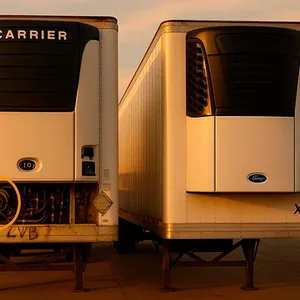


Carrier trailer refrigeration units usually give fleets plenty of warning before they turn into an expensive service event. The warning just does not always arrive as a dramatic failure. It shows up in stretched service intervals, dirty condenser surfaces, weaker starts in cold weather, belt wear that was left for later, uneven recovery after loading, or a reefer that stays active while confidence in the trailer quietly drops. A maintenance program exists to catch that drift before the next load pays for it.
We provide Carrier reefer preventive maintenance for trailer TRUs in Chicago and across Illinois for fleets that need structured PM service, deeper periodic maintenance, seasonal readiness, and credible return-to-service checks. This page covers planned maintenance for Carrier trailer-mounted units. It does not cover emergency repair routing, alarm-code lookup, telematics setup, truck refrigeration units, van units, or trailer body work.
Preventive Maintenance Protects Route Reliability Before the Complaint Changes Shape
A reefer that misses maintenance does not always fail in a way that points back neatly to the missed service. The fleet often sees the result through a different symptom: weaker pull-down, rougher restart behavior, unstable temperature control, or a trailer that needs more attention than it should. Carrier’s own manuals are clear on the principle behind this: ignoring the recommended maintenance schedule affects service life and reliability. That is the operational reason PM belongs in fleet planning rather than in a vague “when time allows” category.
For a fleet manager, PM is not shop housekeeping. It is a method of keeping loaded trailers out of avoidable trouble. The less disciplined the maintenance rhythm becomes, the more often the operation ends up making emergency decisions that should have been prevented while the reefer was still inside a normal service window.
Carrier Reefer Service Intervals Need Discipline, Not Approximation
Trailer units do not wear according to intention. They wear according to run hours, route pressure, standby use, seasonal exposure, starts, stops, and how much work the reefer is actually doing between visits. One trailer can accumulate harder reefer duty in a short stretch than another sees over a much longer period. A maintenance schedule that treats all units as though they age at the same rate usually leaves the busiest equipment under-serviced and the easiest equipment over-serviced.
Carrier documentation repeatedly ties maintenance planning to scheduled service intervals and engine-hour awareness. That is the useful takeaway for this page. A good Carrier reefer maintenance program follows interval logic closely enough that service happens before reliability starts slipping, not after the route has already exposed the weakness.
PM A and PM B Are Useful Service Tiers for Carrier Trailer Units
Carrier literature speaks in terms of scheduled maintenance and recurring service requirements. In fleet service language, those requirements are often grouped into PM A and PM B because the structure is practical. One tier covers recurring reliability work. The other reaches deeper into the unit’s broader condition and catches developing wear before it turns into a repeat service problem.
That framing works because fleets need a maintenance program they can schedule, explain, document, and evaluate. A lighter recurring tier keeps day-to-day reliability from drifting. A deeper periodic tier protects the asset from the slower forms of deterioration that do not always interrupt one trip but do weaken the next several.
Carrier PM A Keeps the Reefer Inside Normal Operating Condition
PM A is the recurring reliability tier. This is where routine service is used to keep the unit from moving out of stable operating condition between larger maintenance windows. On Carrier trailer TRUs, that typically means oil and filter service, fuel-side review, air cleaner attention, condenser and radiator cleanliness, battery and cable condition, belt inspection where the platform requires it, and a visual review of the hardware that keeps the unit physically secure and mechanically credible.
Those items sound ordinary until they are missed often enough that the fleet starts dealing with second-order problems instead. Hard starts. Reduced recovery. Rougher performance during heat or cold. Units that still run but no longer inspire much trust. PM A matters because it interrupts that slide early, while the reefer is still easy to keep inside a dependable operating rhythm.
Carrier PM B Extends Beyond Routine Reliability and Into Whole-Unit Condition
PM B includes the essentials from the recurring tier and then moves into broader review of the unit as an asset. This is where deeper cooling-system service, wider electrical checks, mounting integrity, component condition, and larger fluid-service milestones belong. Carrier manuals also tie long-interval maintenance to items such as coolant-service timing and broader engine-related inspections, which is another reminder that a reefer’s condition cannot be judged only by whether the last routine visit happened recently.
For a commercial fleet, PM B is the interval that protects longer-term stability. A trailer may still look serviceable while collecting the small degradations that shorten the distance to the next breakdown. This tier is where those problems are more likely to be found before the route finds them first.
PM A vs PM B: The Practical Difference for Fleet Operators
PM A is there to preserve routine dependability. PM B is there to verify deeper condition and reduce future failure exposure. One keeps the reefer disciplined between larger visits. The other looks more closely at whether the unit is aging cleanly or carrying issues that routine service alone will not correct.
That difference affects budgeting, scheduling, and release confidence. Not every trailer needs the same depth of service every time it enters the shop. A better program uses the lighter tier to support recurring uptime and the deeper tier to protect the asset before hidden wear becomes route downtime.
Carrier Oil Change and Belt Replacement Have More Value Inside a Real PM Program
Carrier oil change work and belt replacement are familiar maintenance items, but their value rises when they are treated as part of a disciplined program rather than as isolated reactions to visible wear. One completed service item does not prove the reefer is being maintained well. It only proves that one obvious need was handled.
That matters even more on mixed fleets. When familiar tasks are performed without consistent interval control or without regard to surrounding reefer condition, the program looks active while reliability keeps eroding. A well-run PM schedule keeps those common service items tied to broader maintenance logic instead of leaving them to random timing.
Carrier X4 Preventive Maintenance and Carrier Vector Preventive Maintenance Follow Different Emphases
Carrier X4 preventive maintenance and Carrier Vector preventive maintenance can live under one fleet program, but they should not be treated as though they ask for the same attention in the same places. X4 is a belt-driven platform. That makes belt condition, mechanical drive integrity, and related physical checks part of its ongoing PM logic. Carrier’s X4 manuals explicitly include belt tension and mounting-bolt checks in scheduled service review, which is exactly why the platform deserves its own maintenance emphasis.
Vector follows a different path. The E-Drive architecture removes the compressor-belt dependency that defines part of the X4 maintenance profile and shifts more attention toward electrical output, controls behavior, and the wider system context built around that design. Fleets running both platforms need one PM program, but not one flattened maintenance mindset.
Carrier Reefer Summer Maintenance Should Arrive Before Heat Starts Setting the Schedule
Summer puts a trailer unit under a very specific kind of pressure. Heat rejection becomes harder, condenser cleanliness matters more, and any weakness in cooling-side condition becomes easier to expose once the trailer is moving loaded freight instead of sitting in mild conditions. Carrier’s own maintenance language repeatedly points back to condenser and radiator cleanliness for exactly this reason. A dirty surface may look minor in the yard and feel expensive on a loaded July lane.
Carrier reefer summer maintenance is useful when it happens early enough to improve hot-weather readiness before long high-ambient days start testing the fleet. For Chicago and across Illinois, that means treating summer preparation as part of the PM program rather than as something to remember after the first round of hot-weather complaints has already arrived.
Carrier Reefer Winter Maintenance Is About Start Confidence and Cold-Weather Stability
Winter changes what the reefer is being asked to prove. Cooling stress becomes less obvious. Start quality, battery condition, fuel-side readiness, and coolant protection move closer to the center of the maintenance picture. Carrier manuals support that shift directly through checks tied to coolant condition, antifreeze concentration, battery connections, starter operation, and fuel heater review where the equipment includes it.
A trailer that enters winter with weak preparation often stays quiet until the first real cold stretch arrives. Then the fleet gets a no-start, unstable run behavior, or an avoidable service interruption when the unit should already have been ready. Pre-winter service matters because cold weather is unforgiving to maintenance shortcuts that were easy to ignore in moderate conditions.
Seasonal Readiness Needs to Match the Fleet’s Real Operating Calendar
Seasonal readiness is only useful when it arrives before the environment starts applying pressure. A reefer heading into summer without cooling-side preparation and a reefer heading into winter without stronger start and electrical confidence are both examples of maintenance that happened too late to protect the route. The calendar may still say the service was recent. The reefer will say otherwise.
That is one of the reasons structured PM works better than occasional seasonal attention. The more disciplined the interval cadence becomes, the easier it is to line summer and winter preparation up with actual fleet timing instead of hoping the next maintenance window arrives before the next seasonal problem.
Maintenance Records Help the Program Stay Coherent
Maintenance records do not replace service, but they do help a Carrier reefer maintenance program remain coherent from one visit to the next. Pretrip review, engine-hour awareness, service history, and clear documentation of what was completed give the fleet continuity that memory cannot provide. Carrier’s service language around pretrip inspection and engine-hour checks supports that point well: the program works better when the reefer’s condition is being tracked with discipline rather than reconstructed later from incomplete recollection.
Records also make the next decision cleaner. The shop can see what service tier was performed, the fleet can see where the trailer sits in its maintenance cycle, and operations is less likely to send an under-prepared unit into a demanding route simply because nobody had a complete picture at the time.
Verification After PM Should Confirm That the Trailer Is Ready to Work Again
Maintenance is not finished when the wrench work ends. It is finished when the reefer is judged fit to return to normal fleet use with credible operating confidence behind it. Carrier’s reliance on pretrip logic and post-service checks supports that standard. The trailer should leave maintenance as a unit ready for real work, not merely as a unit that has been serviced on paper.
For a commercial fleet, that distinction matters every day. A weak verification step sends uncertainty back into dispatch. A stronger verification step gives the next route a reefer that has been serviced, reviewed, and returned with a cleaner basis for trust.
Good PM Reduces Repeat Repair Exposure Later
One of the clearest signs of a weak maintenance program is repetition. The same trailers become familiar names in the service flow. Hot weather finds the same units first. Winter start complaints collect around the same part of the fleet. Service is happening, but it is happening late, unevenly, or without enough interval discipline to reduce future trouble.
A stronger Carrier PM program interrupts that repetition. Recurring service happens on time. Deeper maintenance is not postponed until the unit complains loudly. Seasonal readiness arrives while the fleet still controls the timing. Verification supports return to service instead of merely concluding the shop visit. That is how preventive maintenance stops being overhead and starts behaving like operational control.
Carrier PM for Trailer TRUs in Chicago and Across Illinois
Carrier preventive maintenance for trailer TRUs works when it is treated as a structured fleet program with a real cadence behind it. PM A protects recurring reliability. PM B gives the fleet a deeper scheduled review of whole-unit condition. Seasonal readiness prepares the reefer for the weather conditions most likely to expose weakness. Verification confirms whether the trailer is ready to go back into regular service with a stronger operating foundation beneath it.
We provide Carrier PM for trailer TRUs in Chicago and across Illinois for fleets that need disciplined service intervals, cleaner route readiness, and stronger control over when reefer service happens. The right outcome is a trailer unit that enters difficult weather better prepared, stays more stable between service windows, and returns to work after maintenance with less uncertainty attached to the next trip.