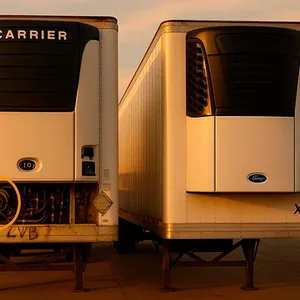


Carrier reefer fuel system diagnostics matter when a refrigerated trailer will crank but not start, starts and dies, stalls later in the run, or comes back with the same restart complaint after the first stop. Those cases get expensive fast because they are easy to misread. A fuel-side problem can be mistaken for an electrical issue, a control issue, or a broad not-cooling complaint long enough for the wrong service path to take over.
We handle carrier fuel system repair and fuel-side diagnostics for Carrier trailer-mounted TRUs on refrigerated 53' trailers in Chicago and across Illinois when the question is whether the failure belongs to delivery, restriction, contamination, air intrusion, or a different lane entirely. This page is built for fleets that need a narrower decision before the unit is released, routed into shop work, or sent toward the wrong kind of repair.
The scope stays limited on purpose. This is not an alarm-code encyclopedia, not a generic mobile reefer page, not PM content, not a parts-replacement page, and not a truck or van refrigeration page. It is a brand-specific service path for fuel-side complaints on Carrier trailer TRUs where cargo protection, route timing, and repeat-failure risk all depend on reading the complaint correctly.
Fuel complaints on Carrier trailer TRUs do not all mean the same thing
A reefer that will not start after a fuel stop is one kind of case. A unit that restarts in the yard, then dies later when the route gets harder, is another. A trailer that stalls after dwell and then behaves differently once it is asked to pull down under load is different again. Fleets often group all of that into one phrase because the operational result looks similar: the trailer is no longer trustworthy. Service cannot stay that broad.
On Carrier equipment, a reefer won't start fuel issue only belongs in the fuel lane once the complaint begins separating itself from the surrounding possibilities. No-crank, blank display, broader control instability, and unrelated shutdown behavior do not point to the same domain. A fuel page has to defend that distinction early or it stops being useful.
The value of a good fuel-system page is not that it explains diesel in general. It helps fleets understand when a Carrier reefer complaint is actually fuel-side, when it is only fuel-like on the surface, and when the next decision should be targeted fuel work instead of another broad reefer repair guess.
How fuel-side failures usually present in fleet operations
Fleets rarely experience fuel problems as textbook lab events. They see them in operating patterns. A trailer leaves a yard, runs well enough for the first part of the move, then begins to lose stability later. Another unit starts after sitting, then dies again after a short hold. Another cranks hard on a cold Illinois morning, catches briefly, and still does not look ready for loaded work. Those are not interchangeable stories.
Fuel-side complaints also behave differently depending on timing. Some show up after a low-fuel event. Some surface after extended dwell. Some only become obvious when the TRU transitions back into heavier demand. Some repeat after the same kind of route interruption. When those details are preserved, the case becomes easier to scope. When they are lost, every no-start starts looking the same and the service lane gets weaker.
| Field complaint | What it may indicate | What still needs to be separated | Why the distinction matters |
|---|---|---|---|
| Cranks but will not stay running | Fuel-side instability may be present | Fuel delivery vs electrical or control-related interruption | The unit should not be routed into the wrong repair lane just because it briefly caught once |
| Starts after sitting, then stalls later | Restriction, air intrusion, or unstable delivery may be in play | Fuel-domain case vs broader engine-side or control-side complaint | Repeat stall risk usually costs more after release than at intake |
| Runs in the yard but weakens after dwell or restart | Fuel behavior may be route-sensitive rather than constant | Fuel issue vs load-related or non-fuel complaint | The next service move depends on whether the pattern can be trusted as fuel-side |
| Will not restart cleanly in winter conditions | Cold-weather fuel behavior may be part of the case | Restriction or fuel condition vs non-fuel no-start logic | Seasonal conditions change how quickly a weak trailer becomes a cargo risk |
| Same trailer returns with repeated stall history | Fuel recurrence may be unresolved | Persistent fuel-side failure vs earlier misdiagnosis | Repeat cases require a narrower read before another release decision is made |
Carrier reefer no-start and hard-start complaints need fuel-domain separation before repair begins
Carrier reefer no start diagnostics and carrier reefer hard start diagnostics belong on this page only when the complaint actually points toward the fuel side of the unit. A hard start after cold soak, a restart failure after low-fuel history, and a stall after brief ignition do not have the same service meaning as a unit that never cranks or a unit that loses display and control response. Those are different paths.
For fleets, the practical issue is simple. If the no-start case is still broad, the repair path is still broad. If the complaint has narrowed into fuel delivery, restriction, contamination, or air-in-fuel logic strongly enough to justify fuel-side work, then the page is doing its job. That separation reduces wasted parts decisions and reduces the number of trailers that come back with the same problem after the first service stop did not really address the right domain.
Fuel-side failure families on Carrier reefer units
Carrier reefer fuel diagnostics become much easier to manage once the complaint is broken into actual fuel-side families instead of staying under one broad label. Restriction cases tend to present as a delivery path that cannot support normal run behavior consistently. Air intrusion tends to matter when the system loses stable fuel continuity and restart behavior becomes part of the complaint. Contamination has a different commercial meaning because it can affect more than one point in the fuel path. Unstable delivery belongs to the lane where fuel is present, but not behaving with the consistency the unit needs under real demand.
Those families are useful because they help service teams avoid collapsing every stall or no-start into the same explanation. They also help fleets understand why one trailer goes straight into a fuel repair path while another needs the case narrowed further first. A page like this should improve routing, not just name possibilities.
Carrier air in fuel diagnostics after loss of fuel continuity
Carrier air in fuel diagnostics belong here because restart instability after a run-out event or after unstable fuel continuity can create a very specific kind of service case. It does not have the same operational meaning as contamination in the system or restriction across the delivery path. The trailer may behave like a general no-start from dispatch's point of view, but the failure family is different and so is the repair lane.
That matters because fleets often talk about fuel problems as one category. They are not. One case may be rooted in lost continuity. Another may involve poor fuel condition. Another may be a restricted delivery path that reveals itself only when the unit is asked to move from a calm state into real operating demand. A serious service page has to make those differences legible without turning into a how-to manual.
Carrier fuel filter restriction diagnostics are not the same as contamination findings
Carrier fuel restriction diagnostics, including carrier fuel filter restriction diagnostics, sit close to contamination cases because the field complaint may sound similar. The reefer starts poorly, stalls, loses run quality, or behaves inconsistently across the same route pattern. The service meaning is not the same. Restriction is a narrower delivery problem. Contamination can widen the case and complicate the next repair decision.
That distinction matters in Chicago and across Illinois because fleets do not have time for vague labels when the trailer is still tied to a real schedule. A broad fuel issue is not operationally useful. A narrower contamination-versus-restriction decision is. It changes whether the unit belongs in targeted fuel-system repair, a deeper shop lane, or a broader case review before the trailer is trusted again. This is also where carrier diesel fuel quality diagnostics begin to matter as a separate supporting angle instead of being treated as a generic dirt-in-fuel story.
Cold-weather fuel behavior changes how Illinois fleets should read these complaints
Carrier cold weather fuel diagnostics matter because Illinois operating conditions do not create a different kind of Carrier TRU, but they do change how fuel-side weakness shows itself. A complaint that stays quiet in moderate weather may surface quickly once the unit faces sub-freezing starts, longer dwell periods, or cold-soaked route restarts. A trailer that seemed merely inconvenient in autumn can become a route-risk problem in winter.
This page is not a winterization guide and not an additive guide. The point is narrower. Cold-weather complaints deserve a different level of suspicion when the pattern points toward fuel-side instability. For fuel diagnostics, the seasonal environment matters because it changes the timing and severity of the failure, and therefore the urgency of getting the service route right.
Dwell, restart, and intermittent stall behavior often tell more than one static no-start
Carrier reefer stall diagnostics become more useful when the operating pattern is captured instead of flattened. A unit that dies after twenty minutes of run time does not present the same story as one that never starts. A trailer that restarts after dwell and then falls back into unstable behavior is not giving the same evidence as one brief no-start in a calm yard environment.
These route patterns matter because fleets often see the complaint only after operations have already changed around it. The trailer was loaded, it waited, it restarted, it moved, then it failed again. That sequence is part of the case. On a fuel-side page, intermittent restart and stall behavior are not side notes. They are often the reason a complaint can finally be narrowed into the fuel domain with enough confidence to justify the next repair path.
When a Carrier fuel-system case stays mobile-fit and when it belongs in the shop
Not every fuel-side case belongs in the same service environment. Some units still fit a field response when the complaint has narrowed enough and the immediate operational problem is controlling the current event. Others belong in a shop path because the failure is intermittent, repeat-prone, or too difficult to trust from a brief field result alone. That distinction matters more than the label on the first phone call.
A trailer that simply needs the event contained is one thing. A trailer with recurring stall history, fuel-side instability that returns under load, or a complaint that still overlaps with non-fuel possibilities is another. A good fuel diagnostics page should help fleets understand why some cases can be stabilized and advanced, while others need a deeper environment for replication, confirmation, and repair sign-off.
What intake details help narrow a Carrier fuel complaint correctly
Fuel-side diagnostics start improving long before a wrench is picked up. The useful intake is not reefer died. It is a more disciplined capture of what the unit actually did. Was it a no-start, hard-start, stall, or restart failure? Did it run first and fail later? Did the issue appear after dwell, after low-fuel history, during cold weather, or after the trailer re-entered a higher-demand phase of the route? Did the trailer hold temperature before the event or was instability already visible earlier?
Carrier platform identity matters too. X4 and Vector do not have to be explained in full for the page to remain useful, but they do need to be identified. Fuel complaints travel through different hardware and control environments, and that affects how a service team reads the case. Better intake reduces false routing. False routing is one of the fastest ways to turn a manageable fuel complaint into a repeat stop with the same trailer still out of trust.
What verified outcome looks like after Carrier fuel system repair
A fuel repair is not complete because the engine restarted once. That is only the beginning of the answer. Verified outcome means the fuel-side complaint no longer controls the unit's behavior, the reefer can run with stable enough fuel delivery for the lane it is being returned to, and the original stall, no-start, or restart instability is no longer the active story of the trailer.
That standard matters because the cost of a weak release is high. A trailer that catches once in the yard and dies again under load is not a good repair outcome. A reefer that restarts but still behaves unpredictably after dwell is not a convincing return-to-route result. Fuel-side verification has to speak to actual operating stability, not just to the fact that the unit came back to life in front of the technician.
Why repeat-failure risk matters in fuel-side complaints
Fuel complaints are easy to mislabel as one-off interruptions. The damage usually comes later. The same trailer returns with another stall. Another hard-start shows up in different wording. The reefer restarts after the second visit and fails again on the next loaded leg. By then the problem is no longer just fuel-side instability. It is weak service routing layered on top of it.
That is why repeat history belongs in the service decision. A recurring fuel-side complaint deserves more than a quick restart and a fresh guess. It needs a narrower read of the failure family, a clearer decision on whether the case still fits field handling, and a stronger verification standard before the unit is sent back into a route where another failure will cost even more.
What this page covers and what it does not
This page covers Carrier fuel-side diagnostics and fuel-system repair logic for refrigerated 53' trailer TRUs operating in Chicago and across Illinois. It is designed around no-start, hard-start, stall, restart instability, fuel restriction, contamination, air intrusion, and the service decisions that follow once those complaints are narrowed into the right lane.
It does not replace the Carrier alarm and diagnostics page, the emergency mobile service page, the PM page, the parts-replacement page, or the model-specific X4 and Vector repair pages. It also does not provide DIY priming, bleeding, or troubleshooting procedures. The job here is narrower and more useful: identify when a Carrier reefer complaint truly belongs to the fuel-system path and explain what a professional repair decision should accomplish.
Carrier Transicold fuel system diagnostics for Chicago and Illinois fleets
A fuel-side complaint is rarely just a bad moment in the yard. It is usually a warning that the next service decision has to be more precise than the first description of the problem. Sometimes the case arrives as reefer fuel system diagnostics. Sometimes it comes in as a reefer won't start fuel issue. Sometimes it looks like a restart complaint that only becomes obvious after dwell or winter exposure. The operational need stays the same: get the unit into the correct fuel-side lane before the next decision gets more expensive.
We provide Carrier and Carrier Transicold fuel system diagnostics, carrier fuel system repair, and fuel-side case routing for refrigerated 53' trailers in Chicago and across Illinois with that goal in mind. The right outcome is not a generic repair label. It is a clean service decision: fuel-side case confirmed or ruled out, the proper repair lane chosen, and the unit verified strongly enough to return to route without carrying the same instability into the next load.