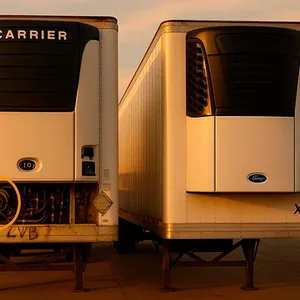


Carrier alarm events matter when they change the service decision, not simply because a message appears on the display. A refrigerated trailer can still be running while temperature control is already slipping, restart reliability is deteriorating, or the route is moving toward a shutdown event that should never have been treated like a minor warning. We provide Carrier diagnostics and alarm assessment, with review of available event records for fleets in Chicago and across Illinois when the job is to read the event correctly before the trailer is released, routed to a shop, or sent back into service.
This page is limited to Carrier diagnostics, alarm interpretation at fleet level, and event-data support on APX and Advance trailer TRUs. It does not provide reset steps, full code charts, menu navigation, or repair procedures. Vector single-temp repair, Vector multi-temp repair, X4 model repair, PM planning, and telematics setup are handled separately.
Carrier Alarm Codes Only Help When They Lead to the Right Service Route
A long list of alarm codes does not help a fleet that has to decide whether a trailer can keep moving under control, needs mobile stabilization, or belongs in a deeper diagnostic lane before the next load. That is where most code pages fail. They stop at the display message. Fleets still have to guess what the event means for temperature control, route-readiness, and release risk.
Carrier APX cases are especially easy to misread. The message on the screen is only one piece of the event. The operating mode, the temperature behavior around the event, whether the alarm repeated, and what the stored history shows usually matter just as much. One warning that never affects temperature is one kind of case. Repeated shutdown, no-temp-control behavior, or a communication event that lines up with box drift is another. The service path changes there, and that is the point of this page.
Identify the Carrier Controller Before Reading the Alarm
Carrier trailer equipment uses controller information matched to the installed platform, including APX and Advance systems. Record the unit model, serial number, controller identity, complete alarm text, and active or stored status before selecting the applicable guide. Thermo King Smart Reefer 4 (SR-4) and Precedent are not Carrier controller or equipment families.
APX uses distributed modules with CAN-bus communication. A reported event can require examination of power, communication, inputs, and actual unit behavior rather than an assumption that one named part has failed. The presence of a code alone does not define the corrective work.
Why APX Diagnostics Need More Than a Basic Code Lookup
Carrier built APX as a decentralized modular control system using CAN-bus communication rather than one large conventional controller. Some alarm events represent system-state problems, communication loss between modules, or protection logic inside the controller environment rather than one obvious single-part failure. Reading the message without reading the platform wastes time and leads fleets into the wrong downstream repair path.
APX also uses a large message environment rather than a tiny code-only mindset. The MessageCenter presents plain-language event text, and that gives fleets something useful to preserve the moment a failure happens. The exact wording on the display, the operating mode, the trip context, and the temperature result around the event belong to the case. Clearing the event before that context is captured weakens the triage and weakens the documentation behind the service decision.
Carrier Alarm Severity and the Unit's Actual Condition
Interpret the displayed message using the applicable Carrier operator information. Preserve any shutdown indication, failed-start history, or loss-of-temperature-control warning together with the operating mode and the observed temperature trend. A message that does not stop the unit is not, by itself, permission to disregard the complaint or a certification of cargo condition.
Alarm Numbers Must Match the Installed Carrier System
A number without its prefix, wording, controller, and unit identity can be misleading. Use the exact displayed event when consulting the relevant Carrier guide; do not transfer Thermo King codes or a generic internet code list into a Carrier diagnosis. Starting, battery-supply, communication, and temperature events each require evidence from the function being investigated.
Repeated shutdowns, failed restarts, or temperature drift should remain open until the cause and next action are established. Clearing the screen does not demonstrate that cooling is restored, and resetting a protection is not a substitute for the applicable service procedure.
What a Fleet Should Capture Before the Alarm Story Changes
Good triage starts with preserving the event before the trailer, the route, or the operator memory moves on. The useful inputs are straightforward: the exact message shown on the display, any visible event identifier or code, whether the unit shut down or restarted, whether box temperature actually moved away from setpoint, whether the event repeated, and whether the trailer was under standby, diesel, dock delay, or active route conditions when it happened.
That record is more valuable than a generic report that the reefer flashed a code. The model family matters. The operating mode matters. The trip timing matters. The gap between the event and the time the trailer reaches service matters as well, because stored history does not remain untouched forever. Delayed triage costs evidence.
Why Data and Log Download Belong in the Service Decision
Carrier's APX ecosystem gives fleets more than a display message when the case is handled correctly. DataLink recording, TRU-Tech, and TRU-View support review of trip history, event history, setpoint information, sensor values, and operating context around the alarm. That is the difference between guessing from one visible code and understanding what actually happened during the route.
For fleet service work, this changes two things immediately. It improves routing, because one isolated warning with stable temperature behavior does not belong in the same lane as repeated shutdown events, recurring no-temp-control messages, or restart failures tied to the same route pattern. It also improves documentation, because event history tied to trip timing and box behavior is far more useful than a cleared screen and a vague verbal description after the fact.
TRU-Tech, TRU-View, and DataLink in Service Context
Carrier's official tool environment matters because it allows service teams to work from more than a live display. TRU-Tech supports APX controller access and monitoring. TRU-View supports downloaded files and event review by trip or by date. DataLink sits underneath that process as the recorder that preserves what the trailer was doing around the event.
The service value is not in the software names themselves. Setpoint history, sensor trends, event timing, and shutdown context help separate a benign event from a route-readiness problem. That is why data and log download belongs in the triage conversation — and why a code encyclopedia without operating context does not answer the question fleets actually need answered.
Seasonal Operating Conditions on Illinois Routes
Include ambient conditions, cold-start history, recent door activity, and the operating mode in the service request. Air-path contamination, power instability, and recovery problems need to be investigated from actual findings, not assigned a specific alarm number from the season alone.
Routine firmware changes, sensor-offset adjustments, and controller resets are not automatic seasonal maintenance tasks. Any such work requires the applicable technical procedure and a supported reason for the identified unit.
Why Waiting Too Long Can Weaken the Case
Recorded history is useful because it captures more than memory and less than a teardown. It also has limits. OEM material warns that stored recorder history is not endless and can be overwritten as memory fills. That is one of the strongest reasons to treat alarm events as evidence worth preserving early instead of something to revisit after several more trips have passed through the unit.
Busy freight operations make this easy to mishandle. One event gets dismissed, another appears later, a third trailer is now late to the dock, and the first case gets pushed aside until the clearest version of the incident is already buried under new recorder data. That weakens triage, weakens documentation, and usually makes the next service decision slower and more expensive.
How Carrier Alarm Cases Route Into the Right Service Path
Not every Carrier APX alarm case belongs in the same downstream workflow. Some units need mobile stabilization because the immediate question is protecting the load and controlling the next movement of the trailer. Some units need shop diagnostics because shutdown history, repeated restart problems, no-temp-control behavior, or communication instability point to a deeper case that should not be settled roadside. Some cases also need to move into the correct model-specific repair path once the alarm domain is identified — especially when the next step depends on whether the trailer is an X4, a Vector single-temp unit, or a Vector multi-temp configuration.
This is where a dispatch-facing diagnostics page earns its value. It separates a display event from a service route. A basic alarm code search does not do that.
Mobile Stabilization vs. Shop Diagnostics After a Carrier Alarm
Mobile work makes sense when the trailer still has a controllable path forward and the immediate risk is operational rather than forensic. A unit that remains under temperature control, shows limited event history, and does not indicate shutdown, no-temp-control behavior, or critical electrical lockout may fit a controlled field response depending on the route and the freight.
Shop diagnostics become more important when the event pattern suggests recurrence, degraded temperature control, communication instability, repeated start failure, or shutdown-class behavior that should be read with logs instead of assumptions. Real-time tools can narrow the case in the field, but a full shop path still matters when the trailer has already crossed from warning event into system-protection territory.
What Verified Outcome Looks Like After an Alarm Case
A verified outcome is not a cleared screen. It is not a unit that restarted once and held briefly in easy conditions. On a Carrier APX or Advance case, release quality depends on whether the event was interpreted in context, whether the right data was preserved, and whether the temperature behavior now matches the route the trailer is supposed to return to.
That standard matters most after no-temp-control messages, shutdown events, repeated failed-start history, battery-voltage instability, communication events tied to route performance, and box-out-of-range incidents that did not recover cleanly. Fleets do not need a cleaner display. They need a reefer that can re-enter service without turning the next trip into an experiment.
What This Page Covers and What It Does Not
This page covers Carrier APX and Advance diagnostics, alarm severity framing, triage logic, high-impact alarm messages and codes, event-data support, and routing decisions after alarm or shutdown events on trailer TRUs. It is built to help fleets understand what kind of case they have and what information matters before the trailer is moved into the wrong service lane.
This page does not provide reset procedures, controller-menu instructions, full alarm encyclopedias, repair steps, or parts-level troubleshooting. It does not replace model-specific repair pages for Vector single-temp units, Vector multi-temp units, or X4 trailer units. Those belong in their own service paths once the alarm case has been scoped correctly.
Carrier APX and Advance Alarm Triage and Data/Log Support in Chicago and Across Illinois
Alarm events on refrigerated trailers cost fleets money in two ways. One is obvious: route interruption, warm product, and unplanned service. The other is slower and usually more expensive: decisions made from incomplete information. A Carrier reefer that is routed correctly after an alarm event is easier to stabilize, easier to diagnose, and less likely to come back under a new complaint after the same underlying issue was never properly understood.
We handle Carrier diagnostics, APX and Advance alarm triage, and data/log download for fleets operating refrigerated trailers in Chicago and across Illinois. The work begins with the event, the operating context, and the available history. The goal is a clean service decision: preserve what matters, read the case correctly, and move the trailer into the right next path for stable return to route.