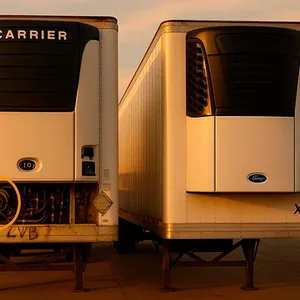


Mobile Carrier reefer repair matters when a refrigerated 53’ trailer is still moving as a live fleet asset, but confidence in the unit is already slipping. Fleets usually search for emergency Carrier reefer repair, 24 hour Carrier reefer repair, Carrier roadside service, or even a Carrier reefer mechanic near me when the complaint is no longer abstract: the box is drifting after loading, the unit shut down between stops, restart behavior turned questionable after a dock delay, or the trailer is still running without looking trustworthy enough for the next leg. On Carrier trailer-mounted TRUs, the real issue is not proximity alone. It is whether the trailer is entering the right service lane before a marginal event becomes a warm-load problem.
Our mobile team handles Carrier trailer TRUs for refrigerated 53’ trailer units in Chicago and across Illinois when the job is to stabilize temperature, restore controlled operation, and decide whether the trailer can be released or routed into deeper shop diagnostics. That scope stays narrow on purpose. It is not truck refrigeration, not van refrigeration, not trailer body repair, and not a page for reset sequences or code-by-code alarm interpretation. It is a brand-specific mobile dispatch lane for Carrier equipment when roadside judgment matters as much as roadside access.
What mobile Carrier reefer repair should mean for fleet operations
For fleet operations, mobile service is not the same thing as a full repair event completed under ideal shop conditions. It is an on-site service lane built to contain the current failure, recover control where that is realistically possible, and judge whether the trailer is fit for the next move. That distinction matters on Carrier equipment because the category already splits into different technical tracks. X4 units belong to one service path. Vector single-temp units belong to another. Vector multi-temp units add compartment logic that changes what a stable outcome means on a live route. A mobile decision made without that platform identity is weaker before the truck ever leaves the shoulder, the yard, or the dock line.
We do not treat every Carrier complaint like one broad reefer-down story. A shutdown-class event is not the same case as a unit that still runs but drifts later. A restart complaint after a fuel stop is not the same case as a weak pull-down complaint after loading. A Vector problem should not be scoped through X4 logic, and an X4 complaint should not be flattened into generic electrical language just because the first phone call was vague.
For this page, the value of mobile service is not simple movement toward the trailer. The value is a better decision about whether the unit can be stabilized on-site, released under controlled conditions, or moved into a deeper repair path.
When a Carrier roadside event belongs in the mobile lane
A Carrier roadside event belongs in the mobile lane when the immediate operational question is whether the load can be protected and the next movement can be controlled. That is different from asking whether the trailer has received a complete permanent repair. Some cases are still mobile-fit because the unit has a workable path forward once the present instability is contained. Other cases already show enough shutdown history, no-temp-control behavior, repeated restart trouble, or route-sensitive drift that roadside release becomes the wrong standard.
Carrier fleets also run through more than one control environment. Some events behave like direct threshold faults. Others make more sense only when they are read against operating mode, restart pattern, event history, and actual temperature behavior around the complaint. That is why a display message alone rarely tells dispatch enough. A stronger mobile decision uses symptom, platform, and route context together.
| Field complaint | What it means for dispatch | Mobile lane fit | What context matters most |
|---|---|---|---|
| Unit is running, but box temperature is drifting | Possible loss of control without a full shutdown | Often mobile-fit first, depending on load risk | Setpoint performance, drift rate, route timing, event history |
| Trailer shut down between stops | Route-readiness problem, not just a nuisance event | Mobile may scope and stabilize; shop escalation may follow | Whether shutdown repeated, whether restart holds, whether temperature stayed protected |
| Unit will not restart after fueling, waiting, or dock dwell | Operating-state complaint with dispatch consequences | Often mobile-fit if the next move can still be controlled | Recent run behavior, battery or fuel context, prior restart history |
| Pull-down is too slow after loading | Performance weakness that may not look dramatic in the yard | Mobile fit depends on live load and next-stop demands | Loaded versus empty behavior, ambient pressure on the route, recovery pattern |
| Repeated event or alarm pattern on the same trailer | Possible comeback cycle rather than an isolated incident | Mobile can narrow the case, but shop path becomes more likely | Repeat count, trip timing, stored records, release history |
Carrier trailer units do not all fail the same way on the road
Carrier mobile work gets better the moment the fleet stops treating the brand as one undifferentiated asset pool. An X4 case usually belongs to a different service conversation from a Vector case. Within Vector, a single-temp trailer on a linehaul lane does not create the same roadside decision as a multi-temp trailer serving compartment-sensitive distribution work. Dispatch does not need to become technical staff, but the asset identity still changes the risk of guessing wrong.
Control generation matters too. Some Carrier event environments are simple enough to read as direct fault signals. Others can reflect module communication state, controller logic, or disagreement between inputs rather than one obvious bad part. Generic roadside language such as “it threw a code and came back” is not enough for a serious release decision. On a busy Illinois lane, the cost of oversimplifying that difference is usually paid later, after the trailer has already been sent back to work.
Common mobile calls we see on Carrier trailer TRUs
Carrier reefer not cooling on the road
This is one of the most expensive calls because the unit may not look completely dead. A trailer can leave a Chicago-area yard appearing acceptable, stay active for the first part of the move, and then start losing temperature authority once the lane gets real. Dispatch is then dealing with a live asset that is technically running and commercially unstable.
On-site service in that situation is not about pretending the trailer is healthy because the engine is still turning. It is about determining whether the temperature loss can be stabilized enough for a controlled next move or whether the case has already crossed into a deeper diagnostic path. That distinction matters most on freight that does not forgive one more optimistic guess.
Carrier reefer shut down between stops
A shutdown call changes the lane immediately. Some shutdowns remain one-event cases once they are read against the surrounding behavior. Others are the surface expression of a trailer that has already stopped being route-ready. We treat those differently because the cost of a weak sign-off is usually paid on the next stop, not at the first one.
A common version is the overnight route that loses the unit on a brief hold, gets it running again once, and then faces a choice before dawn: release, wait, transfer, or reroute. Serious mobile work earns its value there by separating one temporary restart from a trailer that is genuinely ready for the next leg.
Carrier reefer will not restart after fueling, waiting, or dock delay
Restart complaints after dwell are their own category. A unit that ran through part of the day but will not come back cleanly after a pause is not presenting the same story as a trailer that failed from cold start. The mode around the complaint matters. So does the length of the interruption. So does whether the unit had already shown rough behavior earlier in the shift.
We see this pattern often on Illinois freight. The trailer survives the first half of the move, sits, is asked to come back, and suddenly turns a manageable lane into a dispatch problem. Mobile response there is about recovering controlled operation without pretending the event history no longer matters.
Carrier reefer is running, but temperature keeps drifting later in the trip
These are the cases that create arguments because nothing looks completely broken at first glance. A two-stop route can leave the yard well, pass the easy part of the day, and only start slipping once loading, waiting time, and repeat openings begin stacking on the trailer. The unit is still alive. Confidence is not.
That matters because a drifting trailer often comes back under different wording each time: warm box, weak pull-down, late recovery, maybe one alarm, maybe none remembered clearly. Good mobile Carrier reefer service starts by connecting those descriptions back to one real operating pattern instead of letting the case be renamed every time the trailer returns.
What our mobile intake has to identify before the trailer moves again
For fleet operations, a strong intake is part of the service outcome, not a clerical delay before the work starts. The faster the case is scoped correctly, the lower the chance of sending the trailer into the wrong next step. That matters in Chicago yards, suburban dock networks, and longer Illinois routes alike because each environment hides different kinds of failure until timing becomes expensive.
- The Carrier platform on the trailer: X4, Vector single-temp, or Vector multi-temp.
- The live complaint: shutdown, drift, no restart, weak pull-down, standby-related instability, or repeat event behavior.
- Whether box temperature is still controlled or already moving away from the required condition.
- Whether the event repeated and whether the repeat pattern lines up with stops, dock dwell, loading, or route demand.
- Whether event history, trip records, or temperature records are available to support the case.
- Whether the trailer needs immediate containment, controlled release, or direct routing into a deeper shop lane.
Carrier diagnostics have already shown why that intake matters. A warning on the screen is only one part of the story. The operating mode, the actual temperature result, the repeat pattern, and the stored history usually decide whether the trailer belongs in a watch-and-continue lane, a mobile stabilization lane, or a no-shortcuts diagnostic lane.
Stabilize temperature, restore operation, or route to the shop: three different outcomes
Stabilize temperature means the trailer has regained enough control to protect the present load or the immediate next movement under known conditions. Restore operation means the unit is running again in a way that resolves the current dispatch problem. Route to the shop means roadside containment is no longer a serious final standard because the failure pattern already points beyond an on-site release decision.
Those outcomes are related, but they are not interchangeable. A trailer can be stabilized without being fully cleared as a long-term repair success. A trailer can be running again without earning a confident release. A trailer can also be scoped correctly on the road and still belong in a deeper shop lane because the risk sits in recurrence, not in the first visible symptom.
That distinction matters because roadside containment and completed repair are not the same commercial result.
What a credible verification window looks like after mobile Carrier reefer service
For fleet operations, a credible release is not a cleaner display and it is not a single successful restart. It is a short observed window in which the complaint that triggered the mobile call no longer controls the trailer. If the issue was loss of temperature authority, the unit has to behave like it can actually hold the lane it is being returned to. If the issue was restart reliability, the restart question has to stop hanging over the trailer. If the case involved event history or route-sensitive instability, those facts still belong in the release judgment.
Carrier records and event context can matter here even when the roadside complaint sounded simple. Temperature records, trip history, and stored event behavior often tell a cleaner story than memory after a stressful stop. We use that evidence as service support, not as legal theater. The goal is practical: reduce the chance that the same trailer comes back under a slightly different complaint because the first sign-off was thinner than the route demanded.
A real verification window should answer one question clearly: can this trailer go back to work without turning the next load into a test?
Why Chicago and Illinois routes expose weak roadside decisions quickly
Mobile Carrier service in Chicago and across Illinois is not just about mileage coverage. It is about how quickly a weak decision gets exposed once the trailer leaves the immediate service scene. Urban dwell, distribution loops, grocery schedules, live unload windows, and longer interstate runs each stress the unit in different ways. A trailer that looks acceptable in a calm yard can become unreliable once it sees repeated openings, standby transitions, or the next restart cycle.
That is why the same complaint deserves different weight depending on what the trailer is about to do next. A short controlled move into a service facility is one thing. Sending the same trailer back into a demanding route because it restarted once is something else entirely. Serious roadside service has to read the next operating demand, not only the present symptom.
When a generic “Carrier reefer repair near me” result is not enough
A Carrier reefer repair near me, Carrier reefer service near me, Carrier Transicold repair near me, or Carrier reefer mechanic near me search can help dispatch find a local service option. It does not tell the fleet whether the trailer belongs in an on-site stabilization lane, a direct shop lane, or a model-specific repair track after the present event has been contained. That is the gap this service fills.
The same is true of broad searches made under pressure in the middle of the night or between stops. Proximity matters. So does judgment. On a live refrigerated trailer, the closest answer is not always the safest answer if the event history, the operating mode, and the present temperature behavior are all pointing in a different direction.
What stays outside this Carrier mobile service scope
- Full alarm interpretation, code-by-code meanings, and deeper log-download work belong in the Carrier diagnostics and alarm triage page.
- X4 mechanical repair, Vector single-temp repair, and Vector multi-temp repair each stay on their own model-specific service pages once the mobile event has been scoped.
- Planned PM cadence, seasonal readiness, and fleet maintenance structure belong in Carrier PM service.
- Truck refrigeration units, van units, trailer body repair, and DIY or reset guidance are outside this service lane.
That scope line protects the page from trying to do too much at once. It also gives fleets a cleaner route through the site: urgent mobile decision here, deeper diagnostic or model-specific repair where the case actually belongs next.
Carrier roadside service for Chicago and across Illinois fleet operations
Fleets do not always start with the right language. Sometimes the search is Carrier reefer repair. Sometimes it is Carrier reefer unit repair. Sometimes it becomes Carrier reefer trailer repair after a rough stop in the middle of the night. The underlying need is usually more specific than any of those phrases: a brand-specific mobile decision on a Carrier trailer TRU that has already started affecting route trust.
That is why this service stays focused on Carrier trailer-mounted units running refrigerated 53’ trailers in Chicago and across Illinois. The job is to stabilize the present case, restore controlled operation where that is realistic, read the difference between a releasable unit and a shop-only unit, and keep a weak roadside decision from becoming the next load’s problem. Serious Carrier reefer service is not just arrival. Serious Carrier Transicold repair starts when the trailer is routed correctly.